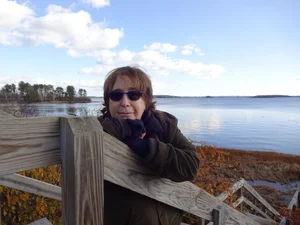
Photographing Ancient Air, Ice Cores & Climate Archive -Suzette Bousema
About Suzette Bousema
Suzette Bousema has breathed in air from 20,000 years ago. She is an emerging Netherlands-based visual artist. Suzette collaborates with environmental scientists to explore present day ecological crises. She engages audiences by using a variety of techniques including photography, glass blowing, and weaving to create experiences for our senses and assist us in wrapping our minds around big, abstract concepts. Suzette has garnered attention through international exhibitions and media coverage in such places as the Netherlands, New York, Kuwait, and France. On the podcast we discuss her project to photograph ancient polar ice cores, create her own climate archive with glass bubbles, and an engaging photograph she took of two men in business attire standing in the ocean. This photograph is Suzette’s way to engage her audience in a conversation about sea level rise and more.
Climate Change, Ice Core Photography, and Glass Art
Suzette wanted to become a veterinarian when she was in high school but her grades prevented her from doing so she took a different career path and the Royal Academy of Art in the Netherlands. For her graduation project she wanted to do something related to global warming. Using the Internet she located a scientist who worked with ice cores. One thing led to another and she found herself photographing 20,000 year old ice core samples from Antarctica. This project led her to create her own CO2 climate archives using glass blowing and scientific techniques to monthly capture samples of air. While Suzette work has garnered attention through international exhibitions and media coverage in such places as the Netherlands, New York, Kuwait, and France, and she has worked in many media our conversation focuses on ice cores, glass bubbles, and an engaging photo she took representing the climate crisis.
Making art helps Suzette get a grip on huge and often abstract topics. By trying to visualize them she is trying to relate by focusing on smaller details on something she can actually manage to deal with.
-
00:00:01 Pamela Ferris-Olson Today on the Wo(men) Mind the Water Artivist Series on womenmindthewater.com, I am speaking with Suzette Bousema, a Netherlands-based visual artist. Suzette focuses on ecological crises and collaborates with environmental scientists. She engages audiences by using a variety of techniques including photography, glass blowing and weaving to create experiences that engage our senses and assist us in wrapping our minds around big abstract concepts.
00:00:35 The Wo(men) Mind the Water Artivist Series podcast on womenmindthewater.com engages artists in conversation about their work and explores their connection with the ocean.
Through their stories, Wo(men) Mind the Water hopes to inspire and encourage action to protect the ocean and her creatures.
I am speaking with Suzette Bousema, an emerging visual artist based in the Netherlands. She has garnered attention through international exhibitions and media coverage in such places as the Netherlands, New York, Kuwait and France. She tackles the subject of climate change through her art. In one of her projects, she photographs ice cores collected in Antarctica and Greenland.
The bubbles trapped in the ice cores document the amount of greenhouse gases in the atmosphere. Some of the bubbles are tens of thousands of years old.
00:01:33 Welcome Suzette. I am grateful to Tracy Metz, another Dutch artist and an earlier guest on the Wo(men) Mind the Water Artivist Series podcast, for introducing me to your work. I'd like to spend much of our time together exploring the subject of ice cores and air bubbles. Let's begin by learning a bit about you and how you became interested in climate change. Help us understand how you became interested in art as a means to explore such a big subject.
00:02:06 Suzette Bousema Well, thank you for the invitation. I'm really happy to be speaking with you about my art. Yeah, how did I grow up? I've always lived by the sea. I live in The Hague in the Netherlands. I think you can see in my projects that they're often related to the sea. For example, for the air catching or the air archive projects, I go to the beach.
00:02:43 Actually I wanted to become a veterinarian when I was in high school but because of some circumstances, like not having high enough grades, I couldn't enter. Another career path was more on the creative side. So I went into art school. Later my fascinations came together and I started making projects about environmental topics.
00:03:14 Pamela Ferris-Olson So you attended the Royal Academy of Art in the Netherlands. How did you come to work with scientists who collect ice? Maybe you could start by describing what an ice core is.
00:03:27 Suzette Bousema An ice core is actually a tubular sample of ice that scientists drill out of the ice sheets on Antarctica. They use a really big machine and kind of make a hole in the ice and then take it up. Then what you see is a lot of layers that go back in time, almost like a book. And actually what you see are very tiny bubbles which are air bubbles that are captured over time. And the way these are formed is by layers of snow. The layers of snow every year add pressure. The weight is actually causing the snow to form into ice. And the air that had been between the snowflakes is now trapped inside the ice as air bubbles. So that's what they dig up when they're doing research. And they can use these ice cores to research the history of climate change. Currently, until about 800,000 years ago. But I think there is now a project where they are trying to go even deeper. Yeah, cores that go back 2,000,000 years ago.
00:04:45 Pamela Ferris-Olson Well, how does somebody who goes to the Academy of Art to study art end up working with scientists collecting ice cores?
00:04:53 Suzette Bousema Well, I knew for my graduation project I wanted to do something with global warming. And I knew that the place where it has the most effect or where the effects of climate change is most visible were the ice caps on the North Pole and the South Pole, especially Greenland where the sea ice is melting very rapidly.
00:05:20 I wanted to know more about it. And then I thought I want to collaborate with the scientist. So actually it was very new to me because of course I was still a student. And yeah, how do you go about it? I actually just googled like: scientist, climate, the Netherlands and Antarctica or something like that. And then someone came up who is actually also the weatherman of the Netherlands. One of the weatherman on the television. And he was also a polar researcher. So I contacted him. Actually it's really nice that all the scientists, they actually work as lecturers at the universities and all have their email on the websites. So it's actually really easy to email them. Very convenient. So that's what I did.
00:06:11 Pamela Ferris-Olson So when did you first see ice cores up close? Did you actually travel to one of the sites of collection?
00:06:19 Suzette Bousema No, I actually first thought I would need to go there. I wanted to go there because how amazing is it to go to the Antarctica or something like that? But then again, I was graduating and within three months or something, I had to have a project. So there was some time pressure. And then I got in contact with the scientist. He told me about his research and that they have in the University of Utrecht where he works, they have a walk in freezer. It's actually a whole room that they keep under -30°C, so very deep freeze. And they have boxes of ice cores there that they have been keeping there since I was born.
00:07:12 Pamela Ferris-Olson Wow. You just walk into a freezer in some city, and there are these ice cores! So you didn't photograph the whole core, you photographed sections, correct?
00:07:27 Suzette Bousema Yeah, I photograph a little slice from the middle. They actually have a saw in the freezer. They have a saw to sometimes make slices, but they usually have a core and make slices like this to them [Suzette demonstrates with her hands cutting the core like a sausage]. But I wanted to make a slice through the middle [she demonstrates slicing the long way] because then you have the whole.
00:07:50 Pamela Ferris-Olson So what technical issues did you encounter photographing the cores in basically a walk in ice chest?
00:08:00 Suzette Bousema So to photograph them, you actually need to let them melt a little bit. You can imagine that when you have block of ice in your freezer, it's like white from the. cold. But when you put it in a glass of water and it starts to melt, it becomes see through and that's actually what I needed to do in order to photograph it and let the bubbles reflect the light. So I took it out of the freezer and I waited until it was going to melt and then when it started to get see through I started photographing. I used flash from behind. So actually a lot of the photograph is black because that's where the shadow is. And actually the only thing you see in the photographs are the bubbles. So you don't actually see the ice in the photographs.
00:08:51 Pamela Ferris-Olson So they didn't mind the little slice that you took was going to melt?
00:08:57 Suzette Bousema Well, actually in the beginning it was very hard because they didn't want to give me an ice core because I was a student. Like I said they’ve kept if for like 25 years for scientific purposes. So they were not really planning to give some ice cores to a random person. But then I started to come more often, and like every time I went back to look I’d ask: “Oh and what's in that box and what is in that box? And then in the end there was one box that they didn't archive very well. They did know that it was from Antarctica from the coordinates but there were some data that they didn't record well in their computer so they couldn't really use them [the data]. Then I got to have those ice cores.
00:09:51 Pamela Ferris-Olson Well, I have to say that your persistence paid off. What kind of technical issues did you encounter in photographing the cores?
00:10:01 Suzette Bousema It's very difficult to photograph something that's melting, especially if it's a block of like this like [demonstrates with her hands] like 10 by 20 centimeters and like a centimeter thick. Every time I stuck it into some kind of thing to hold it standing up because I needed to have it placed somewhere to be able to photograph it. But every time it melted and fell down. So every time I photographed it, it was slowly going down again.
00:10:37 Pamela Ferris-Olson So as you photographed these sections, did you see anything that surprised you?
00:10:42 Suzette Bousema Of course, the bubbles tare trapped in the ice. But as it's melting slowly, some bubbles are released because they are just trapped in a wall of ice. And then you hear the bubbles popping open.
00:10:56 Pamela Ferrris-Olson Really, you hear them popping?
00:10:57 Suzette Bousema Yeah, yeah. You hear like, pop, pop, pop, pop, pop. Because the ice is melting and the air is released. So. Yeah it's kind of fascinating because the ice cores that I photographed were 20,000 years old. So you're breathing in Antarctic air of that time, which is really crazy to imagine.
00:11:18 Pamela Ferris-Olson So how does it feel? How do you feel when you realize that you're breathing air that is from thousands of years ago?
00:11:24 Suzette Bousema Yeah, it's really crazy. Only actually, when you think about it, all the air that is here has been here already, for eternity; only the composition is a bit different. Actually the air that you're breathing right now is also ancient air if you think about it.
00:11:42 Pamela Ferris-Olson You have another project that involves the bubbles, but this time you're blowing your own glass bubbles and the glass bubbles you create contain air that you've collected from pre-selected sites. I believe your intention is to create an archive of air that exists today, similar to the way the air is trapped in the ice core.s How do you go about collecting the air and even more interesting, how do you get it inside the glass bubble?
00:12:12 Suzette Bousema Well, I brought one to show you. So it's a bit easier to explain. The idea was actually that, you know, the air in the ice sheets is like a climate archive of their history.
And if global warming continues, the air of our generation might not be captured in ice or it might be captured, but soon released with the melting and that layer of our history will not be archived. So I began speculating about that and for that reason I wanted to start my own archive.
I wanted to continue with the archive of Antarctica, so I thought I have to go there every month to capture the air there. But of course that's not really sustainable to make a trip every time just to collect some air. I told this to the scientist. What do you think? And then asked if maybe I could do it here?
00:13:18 He said, “well, if it's about the CO2 concentration, you can do it at any place in the world where the air is coming from a relatively clean place. So, for example, when you're standing at the seashore and the air is coming from sea, it is very well mixed already.” CO2 is a very well mixed gas. Whenever you're at a clean place, it's almost the same as in Antarctica.
So that gave me the option that I can do it here near my home.
00:13:53 Pamela Ferris-Olson I can see you could use something like a turkey baster or whatever to suck the air. But then how do you get that air into your glass bubble?
00:14:05 Suzette Bousema The system I use is to blow the bubble first and then I put it on this stick which actually has a vacuum system [Suzette holds up a glass bubble on a pipette]. So you can see that now it's open and now it's closed [demonstrates moving a glass valve on the pipette].
I suck out the air with my mouth and then a slight vacuum is created, then I can close it and go to the beach where I open it. You hear the air at that exact moment go in. I close it again. With a torch I melt the end and the closed bubble is filled with the air from that exact moment at the beach.
00:14:56 Pamela Ferris-Olson Well, thank you for explaining and even more interesting showing us. It's really interesting that you've taken scientific research and moved it into the artistic realm. Do you think you're glass bubble project can be extended beyond the artistic and into the scientific?
00:15:17 Suzette Bousema I'm not sure if they [scientists] will actually use it because it's not an official measurement like they do, but I do capture two bubbles every month. The idea is that one bubble I can use for presentations and exhibitions and the second bubble is for scientific research in the future. So yeah they can use it. They can break it open in 20 years or whenever.
00:15:46 Pamela Ferris-Olson That's really exciting. You're contributing to the knowledge, which is really why I guess you call your glass bubbles “climate archives”. You have them for sale on your website. Each bubble comes with the location and date of where the air was collected and where the sample inside represents. What message or connection do you hope people get by owning a climate archive bubble?
00:16:20 Suzette Bousema Well, the idea was really to see how I can involve my audience more into the project. And I think by making people an archivist or a keeper of the archive, they get a very important role because they are they are actually safeguarding that specific part of the archive. And if it breaks, then we don't have it anymore. So I think this gives some kind of responsibility to the person.
00:16:53 Pamela Ferris-Olson So I'm going to change direction just a little bit because one of the things I find most interesting is a photograph you took back in 2018. And for those in our audience who can't see the photo, it shows two men standing chest deep in the ocean. Both men are wearing white shirts and dark ties. Suzette, what is the story behind this really intriguing photograph?
00:17:18 Suzette Bousema It was for an event for an insurance company. They were holding an event about global warming and how global warming would affect their policies. I’m not sure but the event was called Head above the Water. So how do we keep our head above the water? as I was just very inspired that all these men in business suits were talking about how they can kind of make it better for them, I guess. So I came up with this idea of photography two men in suits in the water with their head just above the water. It was actually a very stormy day so the clouds were very nice and dark.
00:18:11 Pamela Ferris-Olson Very engaging. How did you find two people that were willing to stand in cold water during a stormy day?
00:18:19 Suzette Bousema In the Netherlands, we have this Facebook group called “models and photographers”. Whenever somebody needs like a volunteer, you can ask there. The older guy comes from that platform and the younger guy is a friend of mine.
00:18:36 Pamela Ferris-Olson Ohh, very nice. Definitely a lot of what you do has been courtesy of the Internet. Given the enormity of the issues related to climate change and its consequences for life on Earth, what advice can you offer to listeners who are experiencing climate crisis anxiety?
00:18:56 Suzette Bousema Yeah, that's a really hard one for me. Making these art projects helps me to try at least to get a grip on these huge topics and abstract topics. By trying to visualize it or to give it some kind of embodiment. I'm trying to make a way to relate to it better. So I guess what I'm doing is focusing on very small details of the bigger issue or like a specific effect.
To narrow down maybe and to focus on something that you can actually manage.
00:19:36 Pam Ferris-Olson I fully understand. That's what I'm trying to do with this podcast. It’s fascinating to talk to people, archivists who are handling these issue in different ways. It helps them feel that they're doing something of significance or at least they're moving forward for themselves and hopefully providing people who have anxiety with another way to see how they can deal with it or how other women are dealing with it. And I have to say, I respect the energy with which you are exploring these difficult topics and look forward to hearing more in the future about your work.
I'd like to remind listeners that I've been speaking with Netherlands-based, Suzette Bosma. Suzette is the latest guest on the Wo(men) Mind the water Artivist podcasts. The series can be viewed on womenmyunderwater.com, Museum on Main Street, and YouTube. An audio-only version of this podcast is available on womenunderwater.com, on iTunes and Spotify.
Wo(men) Mind the Water is grateful to Jaine Rice for the use of her song Women of Water. All rights for the Wo(men) Mind the Water name and logo belongs to Pam Ferris-Olson. This is Pam Ferris-Olson.
The Wo(men) Mind the Water Artivist Series podcast on womenmindthewater.com engages artists in conversation about their work and explores their connection with the ocean. Through their stories, Wo(men) Mind the Water hopes to inspire and encourage action to protect the ocean and her creatures.
00:00:46 Pamela Ferris-Olson I'm speaking with Angela Abshier. Angela earned a law degree from the University of Baltimore Law School with a focus on intellectual property law. Angela has worked in many areas of business, including product development. In 2020, she founded Sail to Shelter, a not-for-profit that transforms elite sails into shade and shelter. Angela came up with the idea when she started offshore racing. Her idea was that these strong but lightweight fabrics might be used in settings where permanent construction is too costly and where building supplies might not be readily available or suitable for the purpose.
00:01:30 Pamela Ferris-Olson Welcome, Angela. I am grateful that you are able to join me on the Wo(men) Mind the Water Artivist Series podcast. I'm interested to hear more about your creative solution, but before we explore Sail to Shelter, I'd like to know a little bit about you.
Your story begins in Wyoming, where you grew up. Tell us about Wyoming. What was your life like growing up there?
00:01:54 Angela Abshier Thank you Pam, for having me. I'm so excited to be here. I appreciate the opportunity to share my story. Wyoming is a long way from the water that is for sure. I was born in Arkansas and my father's business moved us to Wyoming where I developed a huge love and respect for nature and being outside and also appreciated that I might like to be outside where it was warmer. So I just turned out to be maybe more of a lizard than a polar bear.
00:02:27 Pamela Ferris-Olson Why did you choose to study journalism when you went off to college?
00:02:32 Angela Abshier I loved words. I wanted to be a speechwriter. And then what happened was Napster happened. When Napster happened, I was appalled at the idea that we weren't going to pay artists for their work and it motivated me to go to law school to try to understand that tension between our commerce and technology. What were we going to do if we weren't going to pay musicians anymore?
00:03:03 Pamela Ferris-Olson OK, so how did you become interested in sailing?
00:03:10 Angela Abshier The beauty of it, the water, the romance. It always has been fascinating to me and it, for some reason, wasn't a yearning for me. It wasn't like I've spent my life trying to get on a sailboat. I mean, I've always appreciated it. I've been on sailing trips. I've done some things, but it wasn't until I got in a race that I was …So whether it was the competition or it just was different, it turned into a different thing from being this beautiful sailing experience into this competitive dance. That you're in this amazing team or that it was completely different.
00:03:56 Pam Ferris-Olson So somewhere along the line you became involved with elite sailing and Grand Prix racing. What do these terms mean and how specialized are they from the general notion of competitive sailing?
00:04:09 Angela Abshier It's a great question. I've spent much of the last four years learning about sail material and how there are as many different sailing materials available as there are
weather patterns around the world, so cloth is made special for different weather conditions and for different boats. I mean it's like thinking of a car and that encompasses Formula One race cars and broken down Pintos. Those are all cars, right? So it's the same as boats. There are just as many options and versions in boats, sailing boats which then would be that many options in sails and more because you can have a million that have a dozen different sails per boat.
00:05:03 Angela Abshier So elite and Grand Prix just move us into really a size and a quality that has durability and functionality requirements that are extraordinary and the material is designed to drag a ship across the ocean. What else can it do?
00:05:23 Pam Ferris-Olson Some of these sails apparently are large enough to cover a soccer field. Between their technical materials and their size, I imagine these sails aren't likely to be inexpensive or easy to purchase. Give us an idea of what a sail might cost and how many companies manufacture these.
00:05:43 Angela Abshier I cannot tell you how much they cost because I don't know. But I will tell you that it is a highly specialized skill set and there are only about four major sail manufacturers and then there are smaller sail manufacturers around the world. But there are four or five major sail manufacturers.
00:06:03 Pam Ferris-Olson This is like the top end of sailing I imagine. So how did you get to be introduced to Grand Prix racing if it's like this really narrow type of racing?
00:06:17 Angela Abshier I just asked a lot of questions. I kept proposing a solution to problems, like humanitarian aid and a valuable second use for the material. And it led me to the material that would be most suited for my needs. Whether it's a feature or a bug, I'm not afraid to write a cold e-mail or make a cold telephone call and ask someone for help. I've been really, really fortunate in the responses from people.
00:06:51 Pam Ferris-Olson Good for you. I like that you've taken the idea of sailing, thought about how to use the sails, and then figured out where you could get sails that would support your idea. Do you know how fast these boats go? I mean, we've got this highly technical sail and they're large.
00:07:12 Angela Abshier 20 knots. You can race above 20 knots, 23 miles an hour. OK, that's a smaller boat. But you can get a boat cooking.
00:07:24 Pam Ferris-Olson OK, it doesn't mean anything to me cause you know, I think of car speeds. But I'm sure when I research it 20 knots is pretty fast.
00:07:34 Angela Abshier 20 knots is 23 miles an hour.
00:07:38 Pam Ferris-Olson Do you think it's the speed or the technological innovation that draws people to the sport?
00:07:45 Angela Abshier It's the water. It's the water that's lovely just being out on the water.
I mean it give me chills just thinking it. We're all just trying to get to the water, right? We're all just blue minds. There isn't anybody that I've met that isn't there because they love the ocean and the water.
00:08:03 Pam Ferris-Olson All right. So you're sailing among people who love the water and some who want to go faster. But how is it that your mind turned to repurposing the sales for humanitarian purposes?
00:08:17 Angela Abshier This is where it gets good. I'll try to keep it brief but at the time I was working in sustainable fashion, creating a secondary marketplace for dead stock material in the garment industry. So there's an entire ecosystem of material that has never been turned into a garment for one reason or another. And because that's what I was doing I had visibility. When I stepped on to a sailboat, I was thinking where is this dead stock going? And then where are these sails going because they're essentially not trash. They're just not winning races anymore. So it's a highly technical tuned instrument and after a few races it might not race as fast. And so because I came up with a mother and a grandmother who saved every piece of ribbon that they ever had off of anything in the world, it's just in my nature to figure out what we are going to do with it next. And when I tried to help, I thought we'll just help with homelessness. These sail are all over and they're located in our in cities that have the worst problem with homelessness. What a perfect solution.
00:09:42 Angela Abshier But when you try to help homeless people in this country, it gets very difficult and it becomes very political. It didn't feel like my calling to solve that problem. It felt like my calling to solve this one. And if I can prove it in disaster areas where people are much less critical over what we're bringing to help them, then I can prove what we can do. Then if anybody wants to take what we've done in these other areas and utilize what we've figured out to help homeless problems in other countries, fine. But for me, the amount of material that is available for this should be used for people who literally have nothing.
00:10:28 Pam Ferris-Olson I think that's really worthwhile. I have to say that living here in Maine, I know there are a number of companies that repurpose sails. They do it into totes and some into clothes. But to my knowledge, no one else has thought of repurposing sales to serve as shelters. So having started my own nonprofit in 2022, I'm aware of the work involved in getting off the ground. It's not easy. What obstacles has sailed to shelter encountered? For example, have you difficulty getting the sails or getting the capital to create the shelters?
00:11:06 Angela Abshier Yes, everything's been difficult. But I don't mind that part. I knew it was going to be difficult. You just prepare for it to be difficult and prepare to solve the problems as they come up. Every time somebody said you can't do it for this reason, this reason and this reason I went to try to figure out how to get over that obstacle. We are in our second year of research at North Carolina State University in the Textile Engineering Department because some of this material, I mean all of it is nothing but polyester. And none of it can be recycled, and all of it is going into landfill. So we're trying to figure out innovative ways to break this down or turn them into road patches or roads or buildings or blocks. But in the meantime, some of the material is extraordinary and can become refugee camps. And so why not?
00:12:10 Pam Ferris-Olson I think I heard you say that you haven't built the shelters yet.
00:12:15 Angela Abshier That's still in a concept form. They're on Maui right now. We are installing a number of different solutions on Maui right now.
00:12:23 Pam Ferris-Olson OK, that's good to know. Well I like the message that you're sending. You knew it was going to be difficult. You were prepared for the frustration and you accepted the challenge. That's great. I hope listeners will think about that when they try and tackle something they want to make a difference in. So why Angela did you choose to devote your personal capital to making this particular vision a reality?
00:12:58 Angela Abshier I mean, I'm not sure that I chose that. I think that as this evolved, don't get me wrong, I'm open to taking money. But I've had to prove. There's been so much resistance. That it's been hard to raise money for it, and so there's been so much in kind donation from transportation grants to architects and engineers who give, who have given me 160 hours. We've had design charettes full of 12 and 15 architects and engineers. We've done amazing things because people really are interested in solving the problem. When you put the material in someone's hands and you explain what we have an opportunity to do, then it comes clear the material just isn't readily available. It's not something you can go buy for they're made for one thing and that one thing most people never see. I believe that the sailing community needs to take responsibility for the sails. They've never done it. Not once. 97% of all sail go into landfill. And they always have. And until somebody does something they always will.
00:14:15 Pam Ferris-Olson So I guess your wildest dream is for Sail to Shelter become so successful that the demand for the shelters will [never] outgrow the availability of supply.
00:14:25 Angela Abshier Well that happen before I ever started [demand for shelter out paces the availability of sail supply].I mean, we'll never be able to. We'll never have an enough sails to help the displaced refugee crisis. And they're not going to quit making sails.
00:14:42 Pam Ferris-Olson OK. I wonder what happens when they run out of petroleum product.
00:14:48 Angela Abshier Wouldn't it be nice?
00:14:51 Pam Ferris-Olson As a person who spends time on the water, I wonder what you think about the state of the ocean.
Where do you think our attention would best be focused?
00:15:02 Angela Abshier Ocean plastic. Get them out.
00:15:06 Pam Ferris-Olson OK, that's a simple, direct answer. We all need to pay attention to that because each one of us can, in our own way, reduce plastic. Angela, do you have advice for listeners who dream of making a positive difference? What if they think they lack the skills to tackle a big idea or simply feel overwhelmed by the notion of taking on a big idea? How might they work toward their dream?
00:15:31 Angela Abshier Just don't give up. It never made sense to me until I had the choice to give up or not give up. And so to me the problem was big enough. If you find a problem in your heart that's big enough and it's different. People are always going to want to do things the same way. But if the system is broken and you have an idea about how you could fix it, or change it, or make it better then it's worth it. So don't give up.
00:16:13 Pam Ferris-Olson All right. Thank you Angela for joining me on the Wo(men) Mind the Water Artivist Series podcast and sharing your story. I think you are a terrific role model. An example of how people, no matter what their background, can find ways to make a positive difference.
00:16:31 Pam Ferris-Olson I'd like to remind listeners that I've been speaking with Angela Absher, a lawyer and product innovator who founded a nonprofit to create emergency shelter alternatives from high tech racing sales fabric that has outlived its original purpose. Angela Abshier is the latest guest on the Wo(men) Mind the Water Artivist Series podcast. The series can be viewed on womenmindthewater.com, Museum on Main Street, and YouTube. An audio-only version of this podcast is available on womenminethewater.com, on iTunes and Spotify. Wo(men) Mind the Water is grateful to Jaine Rice for the use of her song Women of Water. All rights for the Wo(men) Mind the Water name and logo belong to Pam Ferris-Olson. This is Pam Ferris-Olson.