Negotiating Global Environmental Solutions - Susan Gardner
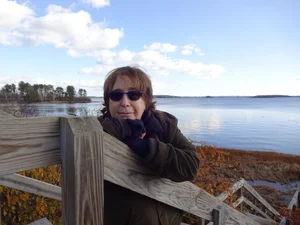
About Susan Gardner
The ocean has always been a special place for Susan. As a young child she enjoyed watching fish in the family’s tank and exploring water with her family. A whole new world opened when she learned to scuba dive. After graduate school, she worked in a remote fishing village on the Pacific coast of Mexico studying sea turtles. She was exposed to the perspectives of those who made their livelihood from the ocean. These experiences have served Susan well as she has worked to negotiate the interconnection of multiple factors in developing environmental treaties. Susan believes that it is vital to make connections between science, people, and policymakers, and that more women need to be involved in the process.
Marine Science, Global Environmental Treaties, and Women’s Voices
Susan Gardner talks about her childhood experiences with water and how learning to scuba dive gave her a new perspective on the ocean. That experience helped inspire her drive to become a marine biologist.
Although Susan was interested in the ocean early on, it was not until graduate school that she had the opportunity to engage more deeply with marine science. Those experiences helped prepare her for the global environmental work she does today.
Now based in East Africa, Susan works with the United Nations Environment Programme, where she helps navigate the complexities of international environmental issues. In global treaty negotiations, each member nation brings different priorities, challenges, and responsibilities that must be understood and considered.
Susan believes women’s voices are especially valuable in these negotiations and works to help include perspectives that have historically been underrepresented. For her, stronger environmental solutions require broader participation, shared knowledge, and a willingness to listen across cultures, communities, and countries.
She remains hopeful about the future. Susan believes science has already provided much of the information needed to guide meaningful environmental action. The work now is to bring that knowledge into policy, cooperation, and solutions that protect the planet’s natural resources.
-
00:00:00 Pam Ferris-Olson Today on the Wo(men) Mind the Water Artivist Series podcast on womenmindthewater.com, I'm speaking with Susan Gardner, Director of the Ecosystems Division for the United Nations Environment Program. Among the many things she does at the UN, Susan has worked to create a global treaty to end plastic pollution.
00:00:22 Susan Gardner is the latest guest on the Wo(men) Mind the Water Artivist Series podcast on womenmindthewater.com. The podcast engages artists in conversation about their work and explores their connection with water. Through their stories, Wo(men) Mind the Water hopes to inspire and encourage action to protect water and all the creatures that depend on it.
00:00:47 Pam Ferris-Olson I am honored to welcome Susan Gardner, who is based in East Africa. She is the Ecosystems Division Director for the United Nations Environmental Program.
00:00:59 Any noise you hear in the background is because Susan is currently attending a United Nations Environmental Program session in New York. So we apologize for any sound issues.
00:01:12 Pam Ferris-Olson Susan says the ocean has always held a special place in her heart. She grew up in the United States where she learned to scuba dive. After graduate school, she worked in a remote fishing village on the Pacific coast of Mexico studying sea turtles. Susan believes that it is vital to make connections between science, people, and policymakers, and that more women need to be involved in the process.
00:01:40 Welcome, Susan. I appreciate that you wanted to be on the Wo(men) Mind the Water Artist Series podcast. I once heard you say something along the lines: It's easy to be pessimistic about the future, but that's not helpful. If we're going to win, we need to get an idea of what is possible.
00:02:00 Pam Ferris-Olson So, Susan, tell us, what were your early experiences with the ocean?
00:02:07 Susan Gardner Well, Pam, thank you for the opportunity to talk with your podcast today. And yeah, well, I'm normally based at the UN Environment Program's headquarters in Nairobi, Kenya. Today, I'm here at the UN headquarters in a negotiation on the High Seas Treaty. So it's a very great place to be talking to you from as we talk about the ocean. And I have to say, you know, I feel like I always wanted to be a marine biologist. I can't remember a time that I didn't. And I think for many of us, those influences come from all sorts of different places, right? Some are, some are more nuanced than others.
00:02:49 Susan Gardner You know, I remember even from as a child, watching those Jacques Cousteau programs on television and just being glued to the television, feeling like I was getting a first glimpse of what was below the surface.
00:03:05 We had a small aquarium at home, and I remember the excitement that when my family would buy even the smallest, simplest little fish to add to the aquarium, we watched how the fish interacted and the changes and just trying to understand this world beneath the water. That was something that we were just learning as we were observing.
00:03:25 Susan Gardner And so I think that I had a number of different influences. My mother used to have a rule that no matter what the water body that we came across, a lake, a stream, a river, the ocean, we always had to put our feet in the water. And so that was something, since I was very little, we took off our shoes, didn't matter the temperature, we would all put our feet in the water. Check that this was one more place where we had stepped into the body of water and so those kinds of influences I think are important in terms of from an early age not being afraid of the water but then beyond that to have small experiences that allow you to build curiosity. You know the saying that you can only really love what you know, something about what you understand.
00:04:14 Susan Gardner And I think by having small exposure to the ocean throughout my childhood and throughout my life, it led me to the point that when I had that first opportunity to learn to scuba dive I was immediate like it wasn't even a question. I immediately knew this was something I wanted to do. And as soon as I put my face in the water that very first time, this was what I wanted to do with my life. It was so something that I just always, always loved.
00:04:41 Pam Ferris-Olson How did you come to study sea turtles in a remote fishing village along the Pacific coast of Mexico? And how did those experiences affect you?
00:04:52 Susan Gardner Well, I had the benefit of growing up in a science family. My father was a scientist and he worked studying air pollution and the effects of air pollution on human health. And so for me, I was familiar with science but and I knew that I wanted to go into marine science. But I wasn't necessarily clear on the pathway. And then it was with my PhD that I had the opportunity to start actually working in the field, doing the kind of work I wanted, with my hands wet, in a canoe, out there, you know, counting plants and critters, and knowing that this was more the direction I wanted.
00:05:31 So this first job to work in Mexico came as an opportunity that I wouldn't have even known to look for. They were looking for somebody who had fisheries experience, which I had for my PhD, somebody who understood contaminants, and somebody who understood marine and coastal ecology. Because this was a program in a fishing village where they were looking at how to address natural resource issues from different perspectives. And it was a very interesting program that looked at it not only from the ecosystem, but also from the social perspective and the economic perspective and brought those three together in order to understand how you can have long-term sustainable solutions for natural resource management. And I really learned, you know, in that experience from day one, what it means to have people and economies and livelihoods as part of the equation for drawing on solutions. And that was enormously impactful for setting the trajectory for the rest of my career and my perspective even today.
00:06:44 Pam Ferris-Olson So what in your mind is the greatest threat to the ocean?
00:06:50 Susan Gardner Well, you know, there's a number of different threats. There's a number of different problems that we have to come together to address. And when you think about the greatest threat, I think it's first important to think about the interconnection of all of the different pressures on marine ecosystems.
00:07:10 So you have things like overfishing that is direct take of fisheries resources that are often managed or need can be managed better. But there's also destructive fishing practices. There's habitat destruction from development, either coastal or unsustainable practices with aquaculture, mining a whole range of things there. And then, of course, at the same time, we have climate change, which is exacerbating all of these things. We get warming of the waters, we get acidification. We get species having to move out of their preferred habitat in search of food or in search of more comfortable temperatures. And together with that, we have a number of pollution sources, oftentimes land-based runoff, you know, from nutrients or domestic sewage, all of these things that actually interconnect.
00:08:13 Susan Gardner And so when we look at how we solve these problems, we have to look at how they intersect, how one affects the other. So, you know, overfishing is harder to control. It's harder to manage a fishery if those fish species are actually moving out of your management area and going to a place where they can find cooler waters. Then all of a sudden you have to change how you're approaching it because the species that you used to manage may have moved off somewhere else and you may have new stocks or species that have come in. And so it creates a lot of uncertainty that our scientists are constantly being challenged to keep up with.
00:08:54 So I would say the threat is, we can't be focused singularly on any particular source.But we have to be looking more holistically at the ecosystems and at the ocean as a whole and looking at the whole combination of factors.
00:09:09 Pam Ferris-Olson So, Susan, many of my guests have talked about segments of what you're referring to, but you're in international decision-making. So how do you manage the competing demands of multiple countries, of different sizes, in different places of the world and having different cultures?
00:09:27 Susan Gardner That's what we have multilateral agreements for, right? That's the whole point, is that countries have to come together and they have to have a space where they can each say, this is my priority, this is what matters to me. They come up with shared goals, the commitments that they all agree must happen, and then they figure out how to do that. And that's what multilateralism is all about. We have, in some cases, regional efforts. Like the Regional Seas Conventions, where they work with smaller numbers of countries in a regional context where they can be able to support each other with shared information, with actually shared enforcement strategies, or working together on monitoring plans.
00:10:15 Susan Gardner But in the multilateral context, we're looking at countries saying: “Look, we've agreed to do this and we've even agreed that we're going to make sure that there's support so that all countries can implement this agreement. And we're going to assure that when we talk about the commitments we made, we get all the countries in the world to come around the table and say we're going to talk. Talk about how we do this and what matters and the timeframe to be able to achieve these things that no one country can do on their own.”
00:10:45 Pam Ferris-Olson So given the complexity of all these competing demands and agendas, how do you personally maintain a positive attitude?
00:10:55 Susan Gardner Well, thank you for saying early on that you remembered something that I had said once about staying hopeful because I mean, that's the way that we keep the vision on where we're headed is by being clear on where we need to go. We don't have time to look backwards and struggle with, you know, what if or we should have. We know there's a lot of we should haves. And in hindsight, you can see a lot of things we could have done better decades ago. But now we have a lot of science. And the science tells us what the problems are. And they also help us to understand how we can address it.
00:11:36 Susan Gardner So one of the things that gives me hope is we have good information. We always need more. We can always have more science. But at the moment, we have enough information to allow us to proceed with solutions that are already available. And so knowing that there are solutions that we can start implementing now, that we have commitments and agreements among countries that we can implement now, that shows there's a path forward.
00:12:03 Susan Gardner And we have another great example of where this has worked as part of the UN Decade on Ecosystem Restoration. Every year we announce winners for flagship awards. And this is a series of efforts where countries or groups of countries have come together and they have had great progress and success in a restoration effort. One example of a recent award winner was in Australia with a shellfish reef building program, where the shellfish were super important in terms of not only as a revenue, as a product, but they were also purifying the water. They were providing habitat for other marine species that were super important for all the things that reefs provide for an ecosystem. And yet they were becoming over harvested. There was sedimentation, there was pollution. There's a whole lot of things that were depleting that resource.
00:13:01 Susan Gardner And so the community decided they were going to fix this. And about five years ago, they started removing nutrient pollution, reducing it. They started increasing stocks. They started looking at ways that they could actually support the regrowth of shellfish reefs, so that they had fishery stock and other biodiversity return. And in the meantime they created jobs, and they helped support small businesses. They connected the local communities to benefits in their livelihoods, benefits in their economies and benefits in their marine environment. So it these kind of win-wins we know they're possible and as long as we keep our eye on that then it's much much easier to stay positive.
00:13:55 Pam Ferris-Olson Great that's good to hear that. So as someone who believes that women are an essential part of the conversation what are you doing to get more women involved?
00:14:06 Susan Gardner It is essential part and you know because we know that these impacts they're not gender neutral. Right? The climate crisis or the nature crisis, not the effects nor the opportunity for solutions. Women have, most studies have seen, disproportionate effects that they experience from crises related to the climate or biodiversity loss. But they also have an outsized impact when they are given responsibilities and opportunities to help with the decisions. So when they have access to resources, there's actually studies that show the health of their family improves, their children's education improves, and the outcome for the resources improves.
00:15:04 Susan Gardner Despite the fact that too often they’re sort of the invisible 90% of the workforce that is underpaid or whose skills are not recognized. So we have good information to show how important it is to empower women in processes of natural resource management. And so one of the things that I personally try to do is talk about it like I'm doing on this podcast right now. You know, talk about how important it is that we make sure that we've got 100% of all of the great minds and the opportunities for efforts there to address these problems.
00:15:42 And also because sometimes when women have a different role in the community or a different role in a cultural context, they see solutions differently. So you bring women to the table in the discussion of solutions, they're going to bring different ideas. They're going to be able to bring a whole different picture of the problem that can be essential in terms of coming up with the solution. And so we make sure that in all of our work at UNEP that our projects and programs have a gender element to them, that we're ensuring that we're not just, you know, sharing the importance of this, but we're incorporating in the work we do.
00:16:23 Susan Gardner So you could look, for example, at Papua New Guinea, where we have you know, loan guarantee mechanisms to make sure that there's finance that's accessible for women-owned coastal businesses. They can have small grants and some mentoring on how to run a business. They can actually, we've seen that have great success with things like growing sustainable aquaculture, developing ecotourism, you know, strengthening cold chains, for example, for the fishery.
00:16:51 We've seen examples in the Philippines where we trained women to be working as rangers. Where they're protecting mangroves, and they're protecting coral reefs. And so it starts to push back against that kind of general standard of thinking of the male in that role. And you get when you get to see women wearing rangers uniforms. And so, you know, those kinds of things begin to push back on what are, you know, are sometimes maybe our own limitations in terms of thinking about what women's role can be.
00:17:27 Pam Ferris-Olson So finally, what would you advise listeners to do so they can be part of the solution?
00:17:34 Susan Gardner Well, I think it's the main thing is essential that everybody do something, that we all act. I think it's essential that, you know, even when there's a temptation to think, you know: “I'm just one person, what can I do?” Or “the real problem is much bigger than me.”
00:17:54 It's out there somewhere that we remember that historically we've seen, you know, one person can make big shifts. Individual steps accumulate to massive movements and we're all part of the solution. And we're all contribute, you know, through the decisions we make, we contribute to the problem or we contribute to the solution. It's just that simple.
00:18:15 Susan Gardner Even if our contributions are small, they add up over a lifetime or over community. And so I think, you know, things that everybody listening can do, start by informing yourself on the things you really care about, the things you're passionate about. Understand the issues, understand the science. Become aware of the solutions. That helps you to, for example, be an informed consumer so that you're aware of the environmental impacts of the decisions that you make. When you have the luxury of being in a situation where you can choose between different products. If you have the opportunity to be a voter, vote with your wallet. Vote, you know, vote with your wallet in terms of what you buy and vote with your vote in terms of what you expect from your leadership.
00:19:07 Susan Gardner And I would say talk about, talk about it. Share what you learn with your family and friends. They're gonna hate it but do it anyway. Use your voice. Use your voice to raise awareness. You know, promote sustainable products. Share the information you've learned. Your voice will inspire others to act and your voice will show what you care about and you should be proud of that. And that helps you push for change. So don't be afraid to speak to people in power. You can let local business owners know why you've chosen them or chosen not them. You can let, you know, your politicians know with a phone call or a letter. You know, you can show what you care about.
00:19:48 Susan Gardner I think the main thing is not to feel overwhelmed by the magnitude of the challenge because every action counts, no matter how big or small. You don't have to be a champion for every environmental cause there is in the world and feel guilty if you can't meet all of them. Choose the ones that resonate most with you and be there as a voice and an advocate to contribute to a future that you want to see for the ecosystems, for species, for the ocean, and for all the people who rely on it.
00:20:19 Pam Ferris-Olson Well said and very motivating. And I have to say it's been a real honor to have you here to lend this perspective.
00:20:27 Pam Ferris-Olson Listeners should know I've been speaking with Susan Gardner, a senior official with United Nations Environmental Program. Susan is the latest guest on the Wo(men) Mind the Water Art of a Series podcast. The series can be viewed on womenmindthewater.com and YouTube. And the audio-only version of this podcast and the transcripts are available on womenmindthewater.com. It's also on iTunes and Spotify.
00:20:55 Pam Ferris-Olson Wo(men) Mind the Water is grateful to Jaine Rice for the use of her song, Women of Water. All rights for the Wo(men) Mind the Water name and logo belong to Pam Ferris Olson. This is Pam Ferris Olson.
00:00:22 Susan Gardner is the latest guest on the Wo(men) Mind the Water Artivist Series podcast on womenmindthewater.com. The podcast engages artists in conversation about their work and explores their connection with water. Through their stories, Wo(men) Mind the Water hopes to inspire and encourage action to protect water and all the creatures that depend on it.
00:00:47 Pam Ferris-Olson I am honored to welcome Susan Gardner, who is based in East Africa. She is the Ecosystems Division Director for the United Nations Environmental Program.
00:00:59 Any noise you hear in the background is because Susan is currently attending a United Nations Environmental Program session in New York. So we apologize for any sound issues.
00:01:12 Pam Ferris-Olson Susan says the ocean has always held a special place in her heart. She grew up in the United States where she learned to scuba dive. After graduate school, she worked in a remote fishing village on the Pacific coast of Mexico studying sea turtles. Susan believes that it is vital to make connections between science, people, and policymakers, and that more women need to be involved in the process.
00:01:40 Welcome, Susan. I appreciate that you wanted to be on the Wo(men) Mind the Water Artist Series podcast. I once heard you say something along the lines: It's easy to be pessimistic about the future, but that's not helpful. If we're going to win, we need to get an idea of what is possible.
00:02:00 Pam Ferris-Olson So, Susan, tell us, what were your early experiences with the ocean?
00:02:07 Susan Gardner Well, Pam, thank you for the opportunity to talk with your podcast today. And yeah, well, I'm normally based at the UN Environment Program's headquarters in Nairobi, Kenya. Today, I'm here at the UN headquarters in a negotiation on the High Seas Treaty. So it's a very great place to be talking to you from as we talk about the ocean. And I have to say, you know, I feel like I always wanted to be a marine biologist. I can't remember a time that I didn't. And I think for many of us, those influences come from all sorts of different places, right? Some are, some are more nuanced than others.
00:02:49 Susan Gardner You know, I remember even from as a child, watching those Jacques Cousteau programs on television and just being glued to the television, feeling like I was getting a first glimpse of what was below the surface.
00:03:05 We had a small aquarium at home, and I remember the excitement that when my family would buy even the smallest, simplest little fish to add to the aquarium, we watched how the fish interacted and the changes and just trying to understand this world beneath the water. That was something that we were just learning as we were observing.
00:03:25 Susan Gardner And so I think that I had a number of different influences. My mother used to have a rule that no matter what the water body that we came across, a lake, a stream, a river, the ocean, we always had to put our feet in the water. And so that was something, since I was very little, we took off our shoes, didn't matter the temperature, we would all put our feet in the water. Check that this was one more place where we had stepped into the body of water and so those kinds of influences I think are important in terms of from an early age not being afraid of the water but then beyond that to have small experiences that allow you to build curiosity. You know the saying that you can only really love what you know, something about what you understand.
00:04:14 Susan Gardner And I think by having small exposure to the ocean throughout my childhood and throughout my life, it led me to the point that when I had that first opportunity to learn to scuba dive I was immediate like it wasn't even a question. I immediately knew this was something I wanted to do. And as soon as I put my face in the water that very first time, this was what I wanted to do with my life. It was so something that I just always, always loved.
00:04:41 Pam Ferris-Olson How did you come to study sea turtles in a remote fishing village along the Pacific coast of Mexico? And how did those experiences affect you?
00:04:52 Susan Gardner Well, I had the benefit of growing up in a science family. My father was a scientist and he worked studying air pollution and the effects of air pollution on human health. And so for me, I was familiar with science but and I knew that I wanted to go into marine science. But I wasn't necessarily clear on the pathway. And then it was with my PhD that I had the opportunity to start actually working in the field, doing the kind of work I wanted, with my hands wet, in a canoe, out there, you know, counting plants and critters, and knowing that this was more the direction I wanted.
00:05:31 So this first job to work in Mexico came as an opportunity that I wouldn't have even known to look for. They were looking for somebody who had fisheries experience, which I had for my PhD, somebody who understood contaminants, and somebody who understood marine and coastal ecology. Because this was a program in a fishing village where they were looking at how to address natural resource issues from different perspectives. And it was a very interesting program that looked at it not only from the ecosystem, but also from the social perspective and the economic perspective and brought those three together in order to understand how you can have long-term sustainable solutions for natural resource management. And I really learned, you know, in that experience from day one, what it means to have people and economies and livelihoods as part of the equation for drawing on solutions. And that was enormously impactful for setting the trajectory for the rest of my career and my perspective even today.
00:06:44 Pam Ferris-Olson So what in your mind is the greatest threat to the ocean?
00:06:50 Susan Gardner Well, you know, there's a number of different threats. There's a number of different problems that we have to come together to address. And when you think about the greatest threat, I think it's first important to think about the interconnection of all of the different pressures on marine ecosystems.
00:07:10 So you have things like overfishing that is direct take of fisheries resources that are often managed or need can be managed better. But there's also destructive fishing practices. There's habitat destruction from development, either coastal or unsustainable practices with aquaculture, mining a whole range of things there. And then, of course, at the same time, we have climate change, which is exacerbating all of these things. We get warming of the waters, we get acidification. We get species having to move out of their preferred habitat in search of food or in search of more comfortable temperatures. And together with that, we have a number of pollution sources, oftentimes land-based runoff, you know, from nutrients or domestic sewage, all of these things that actually interconnect.
00:08:13 Susan Gardner And so when we look at how we solve these problems, we have to look at how they intersect, how one affects the other. So, you know, overfishing is harder to control. It's harder to manage a fishery if those fish species are actually moving out of your management area and going to a place where they can find cooler waters. Then all of a sudden you have to change how you're approaching it because the species that you used to manage may have moved off somewhere else and you may have new stocks or species that have come in. And so it creates a lot of uncertainty that our scientists are constantly being challenged to keep up with.
00:08:54 So I would say the threat is, we can't be focused singularly on any particular source.But we have to be looking more holistically at the ecosystems and at the ocean as a whole and looking at the whole combination of factors.
00:09:09 Pam Ferris-Olson So, Susan, many of my guests have talked about segments of what you're referring to, but you're in international decision-making. So how do you manage the competing demands of multiple countries, of different sizes, in different places of the world and having different cultures?
00:09:27 Susan Gardner That's what we have multilateral agreements for, right? That's the whole point, is that countries have to come together and they have to have a space where they can each say, this is my priority, this is what matters to me. They come up with shared goals, the commitments that they all agree must happen, and then they figure out how to do that. And that's what multilateralism is all about. We have, in some cases, regional efforts. Like the Regional Seas Conventions, where they work with smaller numbers of countries in a regional context where they can be able to support each other with shared information, with actually shared enforcement strategies, or working together on monitoring plans.
00:10:15 Susan Gardner But in the multilateral context, we're looking at countries saying: “Look, we've agreed to do this and we've even agreed that we're going to make sure that there's support so that all countries can implement this agreement. And we're going to assure that when we talk about the commitments we made, we get all the countries in the world to come around the table and say we're going to talk. Talk about how we do this and what matters and the timeframe to be able to achieve these things that no one country can do on their own.”
00:10:45 Pam Ferris-Olson So given the complexity of all these competing demands and agendas, how do you personally maintain a positive attitude?
00:10:55 Susan Gardner Well, thank you for saying early on that you remembered something that I had said once about staying hopeful because I mean, that's the way that we keep the vision on where we're headed is by being clear on where we need to go. We don't have time to look backwards and struggle with, you know, what if or we should have. We know there's a lot of we should haves. And in hindsight, you can see a lot of things we could have done better decades ago. But now we have a lot of science. And the science tells us what the problems are. And they also help us to understand how we can address it.
00:11:36 Susan Gardner So one of the things that gives me hope is we have good information. We always need more. We can always have more science. But at the moment, we have enough information to allow us to proceed with solutions that are already available. And so knowing that there are solutions that we can start implementing now, that we have commitments and agreements among countries that we can implement now, that shows there's a path forward.
00:12:03 Susan Gardner And we have another great example of where this has worked as part of the UN Decade on Ecosystem Restoration. Every year we announce winners for flagship awards. And this is a series of efforts where countries or groups of countries have come together and they have had great progress and success in a restoration effort. One example of a recent award winner was in Australia with a shellfish reef building program, where the shellfish were super important in terms of not only as a revenue, as a product, but they were also purifying the water. They were providing habitat for other marine species that were super important for all the things that reefs provide for an ecosystem. And yet they were becoming over harvested. There was sedimentation, there was pollution. There's a whole lot of things that were depleting that resource.
00:13:01 Susan Gardner And so the community decided they were going to fix this. And about five years ago, they started removing nutrient pollution, reducing it. They started increasing stocks. They started looking at ways that they could actually support the regrowth of shellfish reefs, so that they had fishery stock and other biodiversity return. And in the meantime they created jobs, and they helped support small businesses. They connected the local communities to benefits in their livelihoods, benefits in their economies and benefits in their marine environment. So it these kind of win-wins we know they're possible and as long as we keep our eye on that then it's much much easier to stay positive.
00:13:55 Pam Ferris-Olson Great that's good to hear that. So as someone who believes that women are an essential part of the conversation what are you doing to get more women involved?
00:14:06 Susan Gardner It is essential part and you know because we know that these impacts they're not gender neutral. Right? The climate crisis or the nature crisis, not the effects nor the opportunity for solutions. Women have, most studies have seen, disproportionate effects that they experience from crises related to the climate or biodiversity loss. But they also have an outsized impact when they are given responsibilities and opportunities to help with the decisions. So when they have access to resources, there's actually studies that show the health of their family improves, their children's education improves, and the outcome for the resources improves.
00:15:04 Susan Gardner Despite the fact that too often they’re sort of the invisible 90% of the workforce that is underpaid or whose skills are not recognized. So we have good information to show how important it is to empower women in processes of natural resource management. And so one of the things that I personally try to do is talk about it like I'm doing on this podcast right now. You know, talk about how important it is that we make sure that we've got 100% of all of the great minds and the opportunities for efforts there to address these problems.
00:15:42 And also because sometimes when women have a different role in the community or a different role in a cultural context, they see solutions differently. So you bring women to the table in the discussion of solutions, they're going to bring different ideas. They're going to be able to bring a whole different picture of the problem that can be essential in terms of coming up with the solution. And so we make sure that in all of our work at UNEP that our projects and programs have a gender element to them, that we're ensuring that we're not just, you know, sharing the importance of this, but we're incorporating in the work we do.
00:16:23 Susan Gardner So you could look, for example, at Papua New Guinea, where we have you know, loan guarantee mechanisms to make sure that there's finance that's accessible for women-owned coastal businesses. They can have small grants and some mentoring on how to run a business. They can actually, we've seen that have great success with things like growing sustainable aquaculture, developing ecotourism, you know, strengthening cold chains, for example, for the fishery.
00:16:51 We've seen examples in the Philippines where we trained women to be working as rangers. Where they're protecting mangroves, and they're protecting coral reefs. And so it starts to push back against that kind of general standard of thinking of the male in that role. And you get when you get to see women wearing rangers uniforms. And so, you know, those kinds of things begin to push back on what are, you know, are sometimes maybe our own limitations in terms of thinking about what women's role can be.
00:17:27 Pam Ferris-Olson So finally, what would you advise listeners to do so they can be part of the solution?
00:17:34 Susan Gardner Well, I think it's the main thing is essential that everybody do something, that we all act. I think it's essential that, you know, even when there's a temptation to think, you know: “I'm just one person, what can I do?” Or “the real problem is much bigger than me.”
00:17:54 It's out there somewhere that we remember that historically we've seen, you know, one person can make big shifts. Individual steps accumulate to massive movements and we're all part of the solution. And we're all contribute, you know, through the decisions we make, we contribute to the problem or we contribute to the solution. It's just that simple.
00:18:15 Susan Gardner Even if our contributions are small, they add up over a lifetime or over community. And so I think, you know, things that everybody listening can do, start by informing yourself on the things you really care about, the things you're passionate about. Understand the issues, understand the science. Become aware of the solutions. That helps you to, for example, be an informed consumer so that you're aware of the environmental impacts of the decisions that you make. When you have the luxury of being in a situation where you can choose between different products. If you have the opportunity to be a voter, vote with your wallet. Vote, you know, vote with your wallet in terms of what you buy and vote with your vote in terms of what you expect from your leadership.
00:19:07 Susan Gardner And I would say talk about, talk about it. Share what you learn with your family and friends. They're gonna hate it but do it anyway. Use your voice. Use your voice to raise awareness. You know, promote sustainable products. Share the information you've learned. Your voice will inspire others to act and your voice will show what you care about and you should be proud of that. And that helps you push for change. So don't be afraid to speak to people in power. You can let local business owners know why you've chosen them or chosen not them. You can let, you know, your politicians know with a phone call or a letter. You know, you can show what you care about.
00:19:48 Susan Gardner I think the main thing is not to feel overwhelmed by the magnitude of the challenge because every action counts, no matter how big or small. You don't have to be a champion for every environmental cause there is in the world and feel guilty if you can't meet all of them. Choose the ones that resonate most with you and be there as a voice and an advocate to contribute to a future that you want to see for the ecosystems, for species, for the ocean, and for all the people who rely on it.
00:20:19 Pam Ferris-Olson Well said and very motivating. And I have to say it's been a real honor to have you here to lend this perspective.
00:20:27 Pam Ferris-Olson Listeners should know I've been speaking with Susan Gardner, a senior official with United Nations Environmental Program. Susan is the latest guest on the Wo(men) Mind the Water Art of a Series podcast. The series can be viewed on womenmindthewater.com and YouTube. And the audio-only version of this podcast and the transcripts are available on womenmindthewater.com. It's also on iTunes and Spotify.
00:20:55 Pam Ferris-Olson Wo(men) Mind the Water is grateful to Jaine Rice for the use of her song, Women of Water. All rights for the Wo(men) Mind the Water name and logo belong to Pam Ferris Olson. This is Pam Ferris Olson.