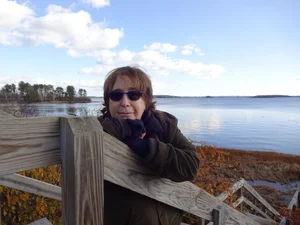
Sea Turtles, Research Creativity and Innovation - Kara Dodge
About Kara Dodge
Kara Dodge is a research scientist at the Anderson Cabot Center, the research arm of the New England Aquarium in Boston. Kara’s specialty is the ecology of marine animals and more specifically sea turtles. There is artistry to Kara's scientific research and her use of cutting-edge technology like satellite tagging and drones. She works to enrich our knowledge of sea turtles and the impacts of humans on them.
Sea Turtle Research, Marine Ecology, and Protecting Ocean Life
Kara Dodge studies the ecology of marine animals, with a focus on sea turtles—especially leatherbacks. She shares how her early experiences working with marine species around the world led her to pursue zoology and oceanography, recognizing that understanding animals requires understanding their environments.
In her work, Kara explains how scientists study sea turtles, particularly the challenge of tracking animals that spend nearly their entire lives at sea. She highlights the use of technology like drones, aerial surveys, and satellite tagging to observe turtles without disturbing them and to better understand their behavior and migration.
She also discusses the biggest threats facing sea turtles today, including bycatch from fishing gear, habitat loss, and climate change. These challenges extend beyond turtles, impacting whales, sharks, and broader ocean ecosystems.
Kara speaks to the evolving culture of marine science, emphasizing the need for more women in leadership and greater diversity in the field—especially scientists from regions where these animals live.
At its core, her work connects science to action. She encourages people to take simple, collective steps—like reducing waste and protecting coastal environments—to help safeguard marine life.
-
00:00:00 Pamela Ferris-Olson Today on the Wo(men) Mind the Water Artivist Series on womenmindthewater.com, I'm speaking with Kara Dodge, a research scientist at the Anderson Cabot Center in Boston. The center is the research arm of the New England Aquarium care specialty is the ecology of marine animals and more specifically, sea turtles. Today Wo(men) Mind the Water talks to Kara about the artistry of her scientific research and her use of cutting edge technology like satellite tagging and drones to enrich our knowledge about sea turtles and the impacts of humans on them.
The Wo(men) Mind the Water Artivist Series podcast on womenmindthewater dot com engages artists in conversation about their work and explores their connection with the ocean. Through their stories, Wo(men) Mind the Water hopes to inspire and encourage action to protect the ocean and her creatures.
00:00:58 Pamela Ferris-Olson I am speaking with Kara Dodge. She is a research scientist interested in the biology and ecology of marine animals. Sea turtles can be particularly challenging to study as they migrate over extensive distances. The information Kara obtains using cutting-edge technology, like satellite tagging and drones, is invaluable when making management and conservation decisions.
Welcome Kara. Your research involves a good deal of creativity and innovation. We appreciate you being here to shed light on the work you do. Let’s begin by finding out something about you.
Where did you grow up and what sparked your interest in learning more about the ocean?
00:01:43 Kara Dodge So I grew up in Scituate, MA, which is a small coastal community that has a really rich maritime history. When I grew up there, there was a pretty omnipresent fisheries. We had a fishing pier, a lot of commercial fishermen coming in and out. There was a traditional industry of Irish mossing and shell fishing. So just a lot of ocean uses going on. And so I grew up kind of in that context. The ocean was sort of ever present in my life. My dad used to make fishing rods. So I started fishing and shellfishing when I was probably barely old enough to walk. So I've had the ocean in my whole life.
00:02:24 Pamela Ferris-Olson OK, well, in an area where it seems you learned a lot about commercial fishing, what led you to a career as a marine researcher?
00:02:33 Kara Dodge I just have this lifelong fascination, interest in the ocean and in marine animals, so I feel like my career really marries those two interests: the ocean and marine life. And the year after I graduated, I spent pretty much an entire year just sort of dipping my toes into different realms of marine research. I did some work on sea turtles and Barbados. I did some work on sandbar sharks in Delaware Bay. I did some work on Lion Fish in Saint Lucia. We were doing some homing experiments with tracking devices. I was just trying to figure out what I wanted to do in my next phase. Then my PhD, I sort of expanded on that by doing a zoology degree which also included oceanography to understand marine animals. You really need to understand their habitats and what drives their behavior. So you need to understand physical and biological oceanographic processes in the ocean and the impacts that has on their behavior. So that's kind of the path that my career took me.
00:03:27 Pamela Ferris-Olson In my experience the field of science, at least in the past when I was studying natural resource management, was a male-dominated culture. What has your experience been? Is the research community in which you work supportive?
00:03:41 Kara Dodge I think that's a really interesting question. And I would say the culture is shifting. I would say in the past, as you said, it has been male-dominated and I would go further and say it was white male dominated. And I do feel like there are more and more women being recruited into science, and that's fantastic. I was recently at a conference and I saw so many, I mean, the majority of presenters were women presenting on these really innovative and exciting research. But what I really want to see is, not enough in my mind, to have more women, you know, joining the joining the field. I want to see these women in leadership roles. So that's why I think we're still lagging a little bit. We need more women in leadership positions. And one of the goals of my career is to sort of help elevate and promote women into these leadership roles, because that's really where we need to be. And also I think we do have a lot of work to do in marine science in general on representation and diversity. There's still not enough people of different backgrounds and races in marine science. So that's where we need to do a lot of work and that's for both men and women.
00:04:42 Kara Dodge And for sea turtles specifically, most of the countries where these sea turtles are originating are in the tropics and subtropics. We need more representation from those areas in the research realm. There's still a lot of domination. I would say with the white research community, you know, doing a lot of the science. We need more scientists from the regions where these turtles are nesting, we really need protected areas there and we need local people leading those efforts. I think we need to be promoting not only women but also people from other geographies.
00:05:14 Pamela Ferris-Olson It might be useful here if you provided a brief description of what it means to be a research scientist. Tell us what it is that you do.
00:05:23 Kara Dodge So I think it depends on what field of science you're in, what a research scientist mean. So I can speak to my own experience. Basically in my role I'm designing research experiments. I'm acquiring the funding and the permits to do the work. I'm doing the field research and analyzing the data and writing the peer reviewed papers and that's sort of a continuous process. In addition to that, we are also expected and desire to do additional services and mentoring. So mentoring students, peer reviewing journal articles and serving on subcommittees for either government or different groups. For example, I'm on a subcommittee looking at offshore wind impacts on sea turtles. Things like that where we're sort of getting outside of the purely academic realm. Specifically in my role at the aquarium, there's a really strong emphasis on education, outreach and science communication. And so I love that about working at an aquarium. They really value that because we really need to be communicating our science to the public. I'm a firm believer that if people don't understand it, they're not going to care about it. So we do a lot of outreach as well.
00:06:27 Pamela Ferris-Olson Did you decide that you wanted to work on sea turtles or was it something that was presented to you and it looked like a good chance to try it?
00:06:36 Kara Dodge I would say almost a little bit of both actually. In the beginning of my career, I would say I was pretty open. I knew I wanted to do something with marine animals and behavior and I was very interested, you know, specifically in ocean animals and not fresh water. So I did have some, you know, a variety of research experiences to sort of get exposure to these different fields and the types of people that worked in them. So part of it is the opportunities I got because I had those diverse experiences. I had some sea turtle training so that when I was employed by the federal government for a period of time, they were looking for someone with that sea turtle background. That sort of launched me into that role for the federal government. But also growing up in New England, I was really fascinated by sea turtles.
00:07:24 Kara Dodge My father was actually a part-time lobsterman in the 60s and early 70s, and he had entangled a leatherback in his fishing gear. I grew up hearing this amazing story of the, you know, 2000 pound turtle. I'm sure it was exaggerated size wise, but yeah, a 2000 pound sea turtle that my dad found in his fishing gear and I just was fascinated. Like, what are these giant sea turtles coming up here? At the time, they had no idea? What was really interesting is when I started my PhD work in 2006, people still didn't really know what they were doing up here. But there was no basic ecological data on leatherback sea turtles in New England, or really any other species of sea turtle in New England. I sort of saw this gap and, of course, being from New England, I thought “oh, I could potentially fill this gap and do that research myself.”
00:08:09 Pamela Ferris-Olson How did you feel when you saw your first sea turtle up close? What surprised you most about the animal or the encounter?
00:08:19 Kara Dodge I think probably like many Millennials, the first sea turtle I saw close is Myrtle, who's New England Aquarium’s giant green sea turtle. I feel like she's sort of the turtle ambassador for a lot of us Northeast people. But obviously that's different than seeing a sea turtle in the wild for the first time. I think the first sea turtles I saw in the wild are nesting turtles. I think the word that sort of encapsulates the feeling is awe. So you're basically watching this ancient animal do this. Basically the nesting process is an ancient ritual that has been largely unchanged for millions of years. You're getting to witness this little time capsule. For anyone who has the opportunity to experience this, I highly recommend it because it really is incredible. So near nesting turtles, the feeling would be awe. And for turtles, specifically leatherbacks which has been my primary work-focused species, I feel like that every time we see one because they're so hard to find, like a needle in a haystack. I feel like you're basically finding a hidden treasure every single time. It's just like, ‘oh, we found one.’ You know, it's just it never gets old. And no matter how many of them I see.
00:09:30 Pamela Ferris-Olson Tell us what they look like.
00:09:31 Kara Dodge Oh man. So I've had many people describe them to me as looking like a dinosaur, and I actually think that's a pretty good description. They’re very pretty prehistoric looking. They are enormous. That's probably the word that first is used to describe leatherbacks. They can be, you know, 1000 to 2000 lbs. They're very, very big animals. Leatherbacks are really dark color, usually black, sometimes with little white speckles. They have this really interesting jaw where, it's like, they have two fangs on their upper jaw. Which is an adaptation for grabbing tearing jellyfish, which is what they eat? They have long, bumpy ridges that run down their shell. They really don't look like other sea turtle species at all. They're the only living member of their family at this point in time. So they're just very unique. They're a very unique looking turtle, very ancient looking and just huge.
00:10:19 Pamela Ferris-Olson To put an exclamation point by what you just said. You said 1000 to 2000 lbs, which means they weigh 1 to 2 tons.
00:10:30 Kara Dodge They are. Yes. And so I, you know, logistically working with them is a little more challenging than working with other species.
00:10:38 Pamela Ferris-Olson So how does one go about studying them?
00:10:41 Kara Dodge For decades, the only way people were studying leatherbacks and a lot of other sea turtle species was on nesting beaches. So basically the nesting females will crawl out of the water to lay their eggs. And they're accessible to researchers who are waiting on the beach to attach tags or take measurements or their samples or whatever they're planning to do. But at sea, which is where they spend the vast majority of their lives, for males 100% of their lives are at sea. Sub adults, juveniles, 100% of their lives are at sea, females 99% of their lives are at sea. So you want to be able to capture that information.
00:11:14 Kara Dodge It's very different to try to go find sea turtles in the ocean and catch them and collect samples and put tags on them. It's just a lot more difficult and the leatherbacks are extra difficult because they are just so big. So what we did for my PhD project is we actually worked with a spotter pilot. We go out on a boat and then we have a spotter pilot flying. He would be looking for the leatherbacks for us and communicating with us on the radio. When he would find one, we would try to get into position and catch it. The next hurdle was catching these gigantic turtles and getting them on to the boat. So all of it was hard. Like finding them was hard. Catching them was hard. Getting them on the boat was hard. And, you know, I mean, I think the big part of field work in general is establishing connection and relationships. So that's something that I spend a lot of time on. So we worked with commercial fishermen to do that project. Some of whom I still work with. They're like extended family members at this point. The spotter pilot I worked with for over 10 years before he retired.
00:12:12 Pamela Ferris-Olson One of the innovative tools that you're using now are drones. They're much discussed in the news today. Would you begin by describing what a drone is and then the ones that you use?
00:12:24 Kara Dodge Yeah. So I will say the drone component of our current work which is in Puerto Rico is really led by my collaborator in Puerto Rico, Luis Crespo. And so he's the one that picked out the drone and decided which parameters he wanted to have. So he's using a DJI Mavic brand, which is actually a pretty lightweight, relatively small units that you can buy on Amazon or buy, you know, it's commercially available. Any recreational person can have a drone, it seems like, but this one is really nice because it has two different types of cameras on it. It allows us to look for leatherbacks at night, which is when they nest. So we can be out on the beach at, you know, one or two AM and it's pitch black. That drone can fly the entire beach in less than 15 minutes. It would normally take us over an hour to walk the beach to look for turtles. And it can basically see the turtle using a visible camera as well as an infrared camera. The detail in the video, I was astounded by the detail. You could see so much in that video. You can see what part of the nesting process the turtle is in, whether she started laying eggs. It's just really incredible technology.
00:13:30 Pamela Ferris-Olson So how have technology like drones enhanced what you've learned? That you didn't have before you had the drones?
00:13:41 Kara Dodge Well, in Puerto Rico, it's enhanced the project in several ways. One way is that we're able to cover the beach and get to the turtles quickly to attach tags. We used to have to use an ATV which is a great tool. An all-terrain vehicle can be disturbing to the turtles, especially during hatching season when the baby turtles are emerging. You just have to be really careful with those on the beach. It means we don't have to rely on that as much anymore because the drone can cover the beach so quickly and find the turtles for us. Then we obviously have the human element of that which is we have to race to the spot where the turtle.
00:14:14 Kara Dodge Yeah, but that's been really, really helpful. And it's also going to be helpful to my collaborator down there in terms of looking at potential threats. So in some areas of the island, there still is some poaching activity. So you can look for poachers and things like that, which would not really be safe to do on foot walk, walking by yourself on the beach and also looking at issues with feral animals. Feral cats and dogs are a big issue for digging nests on some of these beaches. And being able to identify what the most problematic impacts are and being able to address those.
00:14:45 Pamela Ferris-Olson So you've now pointed out poachers and feral animals are dangers to sea turtles. Have you learned about any other dangers facing sea turtles?
00:14:56 Kara Dodge Well, the leading danger to sea turtles worldwide is by catching fishing gear. So that is the, I would say, that is the undisputed cause of global decline in almost all species, if not all species, certainly for leatherbacks. It's a very important issue that needs to be addressed. At this point, we know that bycatch is the leading problem, but we're at a point we're trying to figure out which fisheries and which areas are the most problematic so that we can take what we have for limited resources and really focus in on those problem areas instead of just trying to take care of everything, because that's impossible.
00:15:32 Kara Dodge When you have global fisheries and an animal there is a global mix. A really big issue is to build maps of, especially the ones that are set off of nesting beaches. So during the nesting season, both adult males and females will gather off of the nesting areas in large numbers to breed, and there are gill net fisheries in those same waters. And so these gillnet fisheries can be taking thousands of these, killing thousands of these turtles. In a given season, it's a really big problem and there’s still work to be done there. A loss of habitat is a very big problem as well. That can either be through development of nesting beaches. A big problem is sand mining in some areas. It is a big problem as well. And of course, sea level rise and increased storm intensity from climate change is actually eliminating some nesting beaches already.
00:16:23 Pamela Ferris-Olson Living here in Maine, between the lobster fishery and the crab fishery, we have a lot of problems with North Atlantic right whale getting entangled. There's an argument whether they're being entangled or not, but it seems the North Atlantic right whales are getting tangled in somebody's ropes. So can your work apply to another species like the endangered right whale?
00:16:56 Kara Dodge Yeah. So the entanglement problem is basically the same. It's the same piece of gear that's the problem for right whales and for leatherback sea turtles. So I feel like it's almost the reverse, where it's not so much that we can help the right whale community. It's more the right whale community is sort of helping us in terms of basically less rope in the water is a good thing for all of these marine species. I feel like the work they're doing with on demand fishing gear at this point, you know right now it's an experimental phase, but if that can actually become economically viable that will certainly help leatherback sea turtles. So I almost feel like we're watching what's happening with the right whale community.
00:17:39 Kara Dodge And we're on the front lines of this problem and then hoping for some benefit to the leatherback. So far, there has not been a gear change that has been beneficial. The gear changes so far have been weak links, things like that. The weak link on the line and the other fixes they just don't work. Leatherbacks are not heavy enough to break those lines. They're just not heavy enough to break these lines. And so, you know, there may have been an advantage to sinking ground lines for them. We're not sure because we don't see a lot of them. We don't have a lot of observations of leatherbacks entangling in ground line but taking that buoy line out of the water column will benefit not only the leatherbacks but other species.
00:18:22 Pamela Ferris-Olson Yeah, hopefully we'll find a solution before the right whale and the leatherback go extinct. Finally Kara, given what you've learned about sea turtles and human interactions, what advice do you have for listeners? If they'd like to make a positive difference?
00:18:38 Kara Dodge You can feel it’s overwhelming when people talk about things like, well, you know, make climate change stop. You know, things that you feel like you don't have a lot of control over. But I do think there are things we can do in our daily lives that can be, as you know, as a collective can be really impactful. So just making good choices. I feel like considering the animals that we share our environment with, so keeping sea turtle nesting beaches safe and undeveloped is really important and also making sure our garbage is not entering the ocean. Using less materials that can only be used once like single use items. Create less garbage that may eventually end up in the ocean is something that we can all be doing. You know looking towards an option for your energy sources, looking towards maybe a cleaner energy. These are just little changes we can make in our everyday lives, but as a collective it actually makes a big difference.
00:19:32 Pamela Ferris-Olson Well, thank you so much for being on the Wo(men) Mind the Water Artivist Series podcast. I expect listeners have gained a better understanding about what science researchers do, the life of sea turtles and the growing field of technology and how it's used in learning about the creatures that live in the sea.
I'd like to remind listeners that I have been speaking with Kara Dodge, a research scientist at the Boston-based Anderson Cabot Center who works with sea turtles and innovative technology. Kara Dodge is the latest guest on the Wo(men) Mind the Water Artivist Series podcast. The series can be viewed on Wo(men) Mind the Water dot com, Museum on Main Street, and YouTube. An audio-only version of this podcast is available on womenunderwater.com, on iTunes, and Spotify. Wo(men) Mind the Water is grateful to Jaine Rice for the use of her song Women of Water. All rights for the Wo(men) Mind the Water, name and logo belong to Pam Ferris-Olson. This is Pam Ferris-Olson.