Civil Engineer to Innoceana’s Marine Environmental Advocate - Carlos Mallo Molina
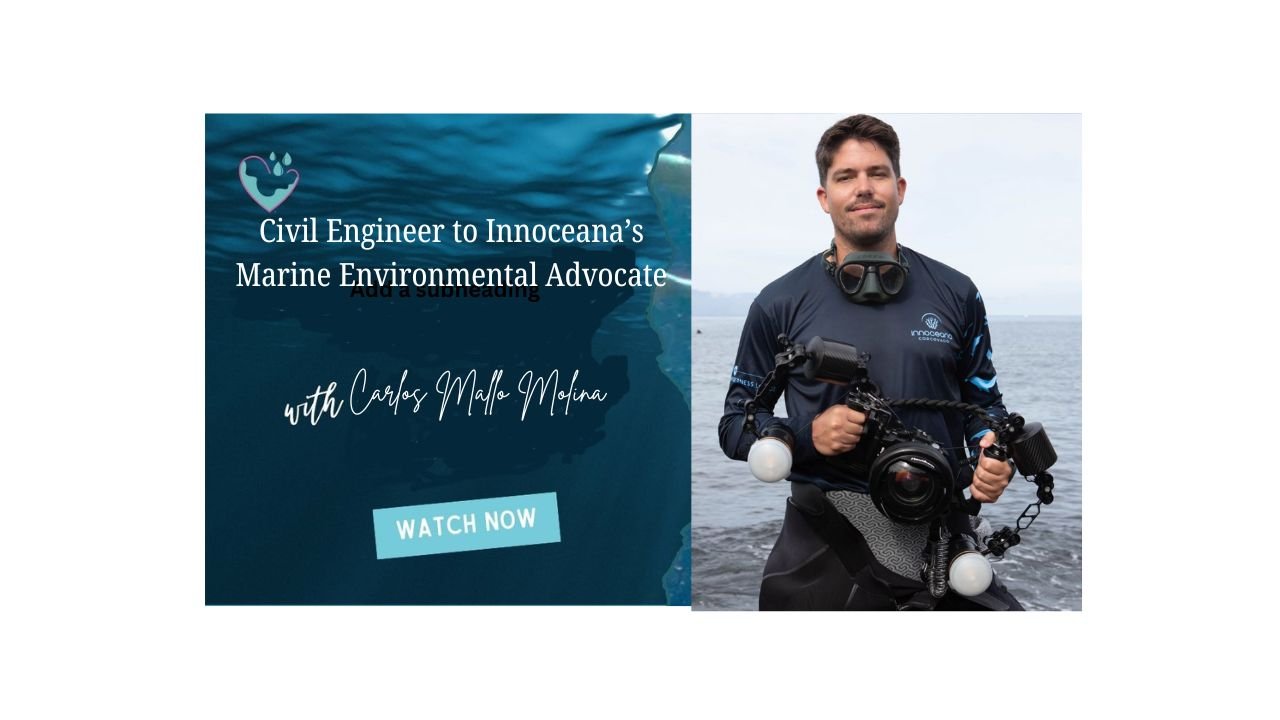
About Carlos Mallo Malina
Carlos Mallo Molina, trained as a civil engineer, discovered a passion for the ocean that led him to found Innoceana, an organization with a mission to protect critically important areas of the ocean. Carlos’ mother “Mama Rosa” encouraged her son as he made a career. She proudly traveled with him in 2025 to receive a Goldman Environmental Prize for his work to halt a port project that threated marine life in the Canary Islands. Carlos leads many initiatives to engage the public in ocean conservation. For example, in Costa Rica, he is investigating the stresses of global warming and working with the local community to protect the coral.
From Civil Engineer to Marine Conservationist and Advocate
Carlos who grew up in northwestern Spain began scuba diving at a young age. He followed in his father’s footsteps and became an environmental engineer. During the ten years he worked in this capacity, he came to realize that his work was not as much in service of the public as in corporations. As he thought about the negative impacts of his work, he found the courage to change his career path and focus on environmental advocacy. Support of his family, particularly his mother helped him make the pivot. The area he first focused on was in the Canary Islands, what Carlos calls – the Hawaii of the Atlantic. It is a hotspot of diversity. For this work he was awarded the Goldman Environmental Prize. The organization he founded - Innoceana - is building a marine education center in the area that had been planned for port infrastructure. His work takes him to other areas’ such as Costa Rica’s Isla del Caño where he is studying the impact of El Niño.
-
00:00:02 Pam Ferris-Olson Today on the Wo(men) Mind the Water Artivist Series podcast on womenmindthewater.com, I'm speaking with Carlos Mallo Molina, a marine conservationist and founder of Innoceana. In 2025, Carlos was awarded a Goldman Environmental Prize. The prize was awarded for Carlos's work in leading Innoceana, an organization with a mission to protect critically important areas of the ocean.
00:00:33 Pam Ferris-Olson Wo(men) Mind the Water Artivist Series podcast on womenmindthewater.com engages artists in conversation about their work and explores their connection with the water. Through their stories, Wo(men) Mind the Water hopes to inspire and encourage action to protect water and all the creatures that depend on it.
00:00:54 Pam Ferris-Olson I'm speaking with Carlos Mallo Molina whose passion is for safeguarding the ocean. He is the founder of Innoceana and leads initiatives to engage the public in ocean conservation. For example, in Costa Rica, he is investigating the stresses of global warming and working with the local community to protect the coral.
00:01:17 Pam Ferris-Olson Welcome, Carlos. You grew up in northwestern Spain, so I presume that you had contact growing up with the Atlantic Ocean. What drew you to take up scuba diving and underwater photography?
00:01:31 Carlos Mallo Molina Hey, Pam, thank you so much for having me in your podcast. And yeah, actually it's a very good timing for that question because I am right now in vacation with my family in the northwest of Spain. And to be honest, it's a little bit of heartbreaking to see how the ocean is really more polluted and doing not the best. But in terms of when I started scuba diving, I can say I don't remember. I was a kid and just my father and my uncles, they put scuba equipment on me. And I think at that time we didn't even have, you know, you learn because your family teach you how to do it. And then I just realized how much I love the ocean. I continued doing it until I started making it more professionally when I was older.
00:02:17 Pam Ferris-Olson You initially chose your career as a civil engineer. Did you ever imagine that you'd be working in a field related to the ocean?
00:02:26 Carlos Mallo Molina Well, to be honest, I was born by the sea and my father is a civil engineer as well, and he was building a port. So I think that connection was always inside me. I was always by the sea. I was always waking up, looking at the ocean, how blue it was. And I was always very inspired by my father working in the ocean. So that was something that was connected to me through the civil engineering. But then when I learned more about the ocean and how complex and how beautiful it is, I just turned into marine conservation to try to do something different.
00:03:01 Pam Ferris-Olson So when did you decide that your work as a civil engineer contributed to the problems rather than addressing them?
00:03:09 Carlos Mallo Molina Yeah, that's a very deep question and I don't have a very short answer for that. I think it was a bunch of different situations that were making me understand that the civil engineers sometimes are at service of giant construction companies that are at service of a society that sometimes is running too fast and we are not thinking about the impact of what we do with our constructions, with our projects. So I think when I became myself a civil engineer and I was in the front line, I could see with my eyes that what we were doing wasn't exactly good for the environment.
00:03:45 Carlos Mallo Molina And I was thinking, if we destroy the environment, that is something that is not infinite. The environment can be destroyed. What is next? We need the environment to live. So I understood, and this is something that was very deep on me when I became a civil engineer. I was told by my teachers that we were working for the society to give solutions to the society. So I was thinking as an engineer, I'm not really giving a solution to the society if I am not putting my energy into saving what we still have in the environment. And in the ocean, of course, that was what triggers me the most.
00:04:21 Pam Ferris-Olson So your job as a civil engineer, you left it to start an environmental nonprofit that lobbies against destructive projects. Where did you find the courage to make the change?
00:04:34 Carlos Mallo Molina Well, I was 10 years working as a civil engineer and in different projects in different countries. And of course, I was building like inside me, I was building something that was like giving me the purpose to do something different. And it was hard because my father, as a civil engineer, I was his dream. He was following me in my career, and my career was going really, really good. So eventually, when I took the courage to say, this is not for me, I want to do something different, I have another part of my family that is my mother that was like, OK, I think you should do it.
00:05:08 Carlos Mallo Molina So it was like I have some people also in the way that were really pushing me and helping me to take the decision. But it was hard because when you do that, in general, society is telling you, what are you doing? You are throwing away a job that you have been 10 years building up and you are throwing away a career and you are throwing away your future. But the truth is that now that I've been almost ten years in the other side, I didn't throw away anything. I'm using my background in civil engineering every day.
00:05:39 Pam Ferris-Olson So describe the area and why you were concerned about the proposed project for that area. And maybe you could start by telling us something about the Canary Islands, because I don't know, I've never been there and I'm sure many of my listeners have never been to the Canary Islands.
00:05:56 Carlos Mallo Molina Well, I think the best way to understand the Canary Islands quickly is that you can imagine this is the Hawaiian, European Hawaii. Basically, this is similar to Hawaii in some ways, but they are close to Africa. So in a different region of the world, we have some volcanic island. There are eight islands, and two of them are pretty big. So one is Tenerife and the other one is Gran Canaria.
00:06:22 Carlos Mallo Molina The one I've been most connected with is Tenerife. And to describe you how this island are, well, you can imagine we are in the middle of the Atlantic Ocean, a lot of whales all around the islands, very beautiful volcanic cliffs, and just islands full of life. And there is, not many people know this, but we have more endemic species in the Canary Islands than there are in Galapagos. So it's really a hotspot of biodiversity.
00:06:48 Carlos Mallo Molina But that's one of the sides of the coin. In the other side of the coin we have 18 million tourists going every year, so they are massively threatened by the tourist industry. And this is something that breaks my heart every time seeing how the tourists is not being used wisely because we have too much. We are not able to manage and when this project of Fonsalía was coming to a reality, this problem was very clear.
00:07:21 Carlos Mallo Molina Like we don't need more ports to attract more tourists and to have more boats in a place that there is a lot of whales. There is a lot of marine life. Plus more boats means more noise in the ocean, more pollution in the ocean and a lot of other problems that you know, Pam. It was easy to say, “Okay.” In the past I was actually building a road that was going to connect that port. But when I quit my job as a civil engineer and I started the organization Innoceana, it was easy for me to join the community into opposing the construction of the port.
00:07:56 Pam Ferris-Olson So in April, you traveled to San Francisco to receive a Goldman Environmental Award that was given for your work to halt the port construction in the Canary Islands. What does that award mean to you?
00:08:09 Carlos Mallo Molina When I received the notification that I was going to be awarded with the Goldman Environmental Prize, I just fall on the floor. [laughing] I almost faint because it was just incredible for me to really digest such an achievement. So last year, as you said, I have the honor to go to San Francisco in April and receive the Goldman Environmental Prize. And that changed my life in many ways. I think in some, most of them good ways, and some of them were also hard to, you know, digesting a thing like this and all of the media pools and all of the new opportunities was overwhelming.
00:08:47 Carlos Mallo Molina And I was already, like about, to burn out because all of the work I'm already doing within Innoceana and suddenly I have all of these media attention and opportunities. So it was beautiful. It was amazing. It was a recognition of many years of work and a recognition of changing my life into doing something different that serves the society, in my opinion. But also the world was not only reflecting me as an engineer opposing the construction of the port. It was also because we were able to achieve working with Innoceana to build a marine conservation center; and that is going to have a school for marine education and a lot of other, basically in the place where the port was going to be built, we are building now a marine conservation center. And that was also part of the recognition. So for me it was like, this makes sense. I've been doing all this work and now I'm having the validation.
00:09:43 Pam Ferris-Olson Well, you had the support of your mother and now you have the support of the world and bravo.
00:09:50 Carlos Mallo Molina And it's funny because my mom came to San Francisco with me because the Goldman is not just an award. It's a whole month of, you go to many places, you meet a lot of people, you can talk about your work. And my mom was there with me and everybody was calling her Mama Rosa because she's called Rosa. So it was really amazing having her. And she was very proud also because she believed in me when nobody was believing in me. So that was great.
00:10:14 Pam Ferris-Olson So during the last El Nino, you documented a loss of 40% of coral in a different area of the ocean. Costa Rica's Isla de Caño is an ecologically important reef area. Talk about your efforts to amplify local voices and why this is an important for marine conservation.
00:10:34 Carlos Mallo Molina It's a hot spot of biodiversity, the whole country. But when it comes to the Pacific Ocean, we have one of the most incredible spots for marine biodiversity. And there are two, the two most preserved and the most beautiful reef, coral reefs in Costa Rica are the number one is Cocoa Island. That is an island two days by boat. You need to take a boat and go two days off of the sea. And then it's Caño Island. That is a smaller version. Caño Islands in the Pacific South.
00:11:04 Carlos Mallo Molina And that's where I was able to start a nonprofit organization that is also Innoceana. It's a nonprofit in Costa Rica. And when I started working with my team there in 2018, we were preparing for El Niño, but we weren't ready. In 2022, 2023, El Niño hit so hard and we lost 40% of the chorus. Even that we were preparing ourselves for that situation, it was really shocking seeing the ocean under the water all white and all the coral bleaching and a lot of coral dying. It was really hard. Which makes it even harder is that this year we are expecting a hotter Niño, like probably one of the hottest Niño in the recent history.
00:11:43 Carlos Mallo Molina So climate change is happening. The changes are happening too fast. This is not a new reality. The reality is getting worse all the time. And we need to do something. We need to change a lot of things in the model of the society and the model of consumerism, because otherwise we are going to struggle a lot.
00:12:03 Pam Ferris-Olson It takes a lot of passion and self-possession. And you have Mama Rosa to help to leave a career you train for and step into a role as a full-time advocate for a healthy marine environment. So I want to thank you for your work and your belief that local communities are key to sustaining the work that needs to be done. You are a testament to the idea that one person's action can make a difference. I want to thank you.
00:12:34 Pam Ferris-Olson I want listeners to know that I've been speaking with Carlos Mallo Molina. Carlos is the latest guest on the Wo(men) Mind the Water Art of a Series podcast. The series can be viewed on womenmindthewater.com and YouTube. A transcript is available on womenmindthewater.com and an audio only version can be heard on iTunes and Spotify.
Wo(men) Mind the Water is grateful to Jaine Rice for the use of her song, Women of Water. All rights for the Wo(men) Mind the Water name and logo belong to Pam Ferris-Olson. This is Pam Ferris-Olson.