Water Women Who Weave Mussels into Gold Binding Mothers to Daughters - Bonnie Blaylock
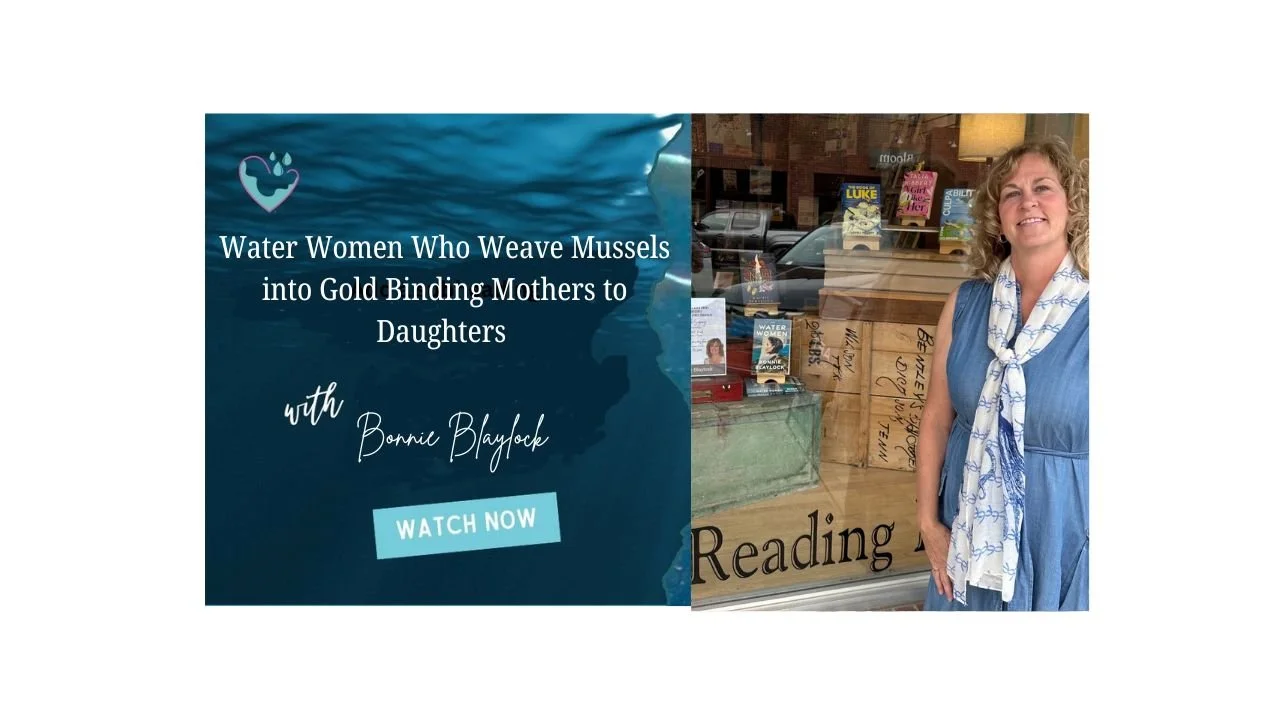
About Bonnie Blaylock
Bonnie Blaylock is author of several books including The Water Women. The Florida resident wrote an engaging novel that explores the bonds between mothers and daughters through a multigenerational practice of using the beards of Pinna nobilis mussel for threads. The threads that they create from the marine mollusk if sued to weave a special cloth. This labor-intensive activity creates strong bonds that binds the women to one another.
Pinna Nobilis, Multigenerational Art of Weaving Mollusk Beards and Story about Mothers and Daughter
The Water Women, the second novel of American historical fiction writer Bonnie Blaylock, is set in Sardinia. The historical features the ancient art of weaving the beards of the giant mussel Pinna nobilis into a golden fabric. While the story is fictional, the craft is real and, in fact, continues; however, both the mollusk and the weavers are endangered. It is a gripping novel that focuses on three generations of mothers and daughters who dedicate themselves to the craft. The golden cloth they create is given, never sold.
-
00:00:01 Pam Ferris-Olson Today on the Wo(men) Mind the Water Artivist Series podcast on womenmindthewater.com, I am speaking with Bonnie Blaylock, the author of several books including The Water Women, an engaging novel that explores the bonds between mothers and daughters. In her book, threads made from a marine mollusk are used to weave a special cloth. These threads also bind the women who weave them.
00:00:28 Pam Ferris-Olson Wo(men) Mind the Water Artist Series podcast on womenmindthewater.com engages artists in conversation about their work and explores their connection with water. Through their stories, Wo(men) Mind the Water hopes to inspire and encourage action to protect water and all the creatures that depend on it.
00:00:49 Pam Ferris-Olson I'm speaking with Bonnie Blaylock, who grew up on the Space Coast of Florida. Her grandfather was a commercial fisherman in the Gulf waters off of Panama City. Bonnie's life followed a different path. She began her career as a writer of technical and environmental reports. When she saw a photograph online of the fabric woven from mussels, it became the stuff from which her book, The Water Women was created. Bonnie has never visited the island of Sardinia, where byssus [mussel beards or threads] and her novel are set.
00:01:24 Pam Ferris-Olson Welcome, Bonnie. I am excited to talk to you about your novel. It focuses on women and their connection to the sea and mussels. I want to know more about how you came to write a historical yarn that speaks to human relationships and commitment to the ocean. So, Bonnie, The Water Woman is your second novel. Your first, Light to the Hills, takes place in Appalachia. Why did you choose to set your second novel outside of the US?
00:01:57 Bonnie Blaylock I found this piece, as you said, of byssus; this photo of byssus and the mollusk and thought it was fascinating, something I'd never heard of before. And I love to learn myself when I'm reading something. I love to learn something new. So I think I knew just I had just enough experience with the ocean in my own childhood, with the sea and experiences along the coastline that I just wanted to explore that. And I love the theme of mothers and daughters that was also in my first book. So I just thought, “Well, let's just pick that theme up and put it in a different setting.”
00:02:32 Bonnie Blaylock Byssus in particular, the weaving of it, has been passed from mother to daughter for 24 generations, some 3000 years. So that theme of mothers and daughters was easy enough to pick up and thread together, so to speak.
00:02:48 Pam Ferris-Olson So one of the gold standards of writing is always, we're told, to write what we know. So how did you manage to write a story about an Italian island, a place you have never personally visited?
00:03:04 Bonnie Blaylock There's a lot of Google Maps going on with that. There's a lot of Internet research when you write historical fiction research is the name of the game. So readers of historical fiction are on top of it. They know when things are not right in the historical timeline. They know when it's like your flora and fauna are not correct.
So I really had to do a deep dive with travel guides and maps and anything I could get my hands on since I wasn't there. I have been to Italy, so that did help with the culture a little bit. But Sardinia is significantly different than the mainland of Italy. So it was a lot of imagination and hand in hand with research, I would say.
00:03:48 Pam Ferris-Olson That's quite a challenge when you tell me that readers are well versed in what a place is like. What firsthand experience have you had with mussels?
00:04:00 Bonnie Blaylock Well, when I was a kid, I lived on the Space Coast of Florida down near Melbourne, Satellite Beach, Cocoa Beach. And we had a boat and we would go on most every weekend, hop in the boat and go to these little barrier islands off the coast. And when we were there, we would do - our picnic lunch would be. There were five of us, I'm one of five and we would dig at the shoreline for clams and mussels and pop them on the grill. And after a little while, they'd pop open and you'd just eat them with ketchup and that would be our lunch. So we had firsthand knowledge, I guess, that way of digging and eating clams.
00:04:35 Bonnie Blaylock It's a little different than the New England type of clams. What are they called? Quahogs, I think. But other than that, nothing. I mean, we would toss our nets off the bridges at night and catch shrimp and those types of things. But I had no experience with mussels other than what I've just described. So yeah, I'm not a biological expert on them or anything but I learned quite a bit about them in the writing of the book. Yeah.
00:05:03 Pam Ferris-Olson So you do a lot of research. So what did you learn about mollusks that surprised you? Or did you learn anything that surprised you?
00:05:13 Bonnie Blaylock Oh sure, yeah. Well, mollusk is like the overall arching term for mussels. So mollusks involve, it's a broad category I guess, classification of anything without a spine. So octopus is a mollusk, a squid is a mollusk, snails, and also the bivalve kinds of creatures that you're familiar with, clams, oysters, mussels. So the creature in this book that I'm focused on is the Pinna nobilis, and it is endemic to the Mediterranean. And it's the largest one in the world. So it's usually one to two feet in length but it can get up to four feet which is the size of a small child, if you can imagine. And I learned that they anchor themselves.
00:06:03 Bonnie Blaylock So the Pinna nobilis, the big fan shell that's in the book, in particular, grows upright. Most clams, the ones that we were digging for as kids, are in the ground buried under the sand. But the Pinna nobilis grows upright. And to do that, it needs to anchor itself in the substrate of, in this case, it's usually seagrass or sand, and it grows these fibers – byssus, what the term is, like a beard, a mussel beard. And that's what it anchors itself to in the substrate while it filters the water and cleans the water and purifies the water. It provides an ecosystem for other creatures like little shrimp live inside of it, little tiny crabs live inside of it, kind of a symbiotic relationship there. So I just learned a ton about mussels and what they are and where they live and what they provide to the ocean ecosystem.
00:06:56 Bonnie Blaylock It was kind of interesting. And that's what the women in the book would do. They go down and harvest these. They'd pull them up gently from the sea floor. Cut those little fibers off that they've anchored themselves to the sea floor with and use those through this lengthy process of processing it and weaving it and making beautiful cloth that shines like gold in the sun. So it's crazy. It's a crazy process. Who knew that it even existed and has existed for some 3,000 years? Pretty cool.
00:07:26 Pam Ferris-Olson So did you say that these byssus mussels grow to be a foot or two feet in length?
00:07:34 Bonnie Blaylock Yes.
00:07:37 Pam Ferris-Olson I had this vision of these little muscles. [Makes an oval-like shape using the first and second fingers on one hand]. That's a big pull! Right?
00:07:43 Bonnie Blaylock So they live can live 40 or 50 years and in that time they have a rapid growth rate so they can get up to four feet in length, but most of the time they're around two.
00:07:53 Pam Ferris-Olson That sounds like two or three women need to pull one of those up. Oh my goodness! So were you surprised to learn that this particular mussel had what they call beards that anchored them into the ground? Because it, indeed, sounds like something from science fiction.
00:08:13 Bonnie Blaylock Yeah, it does. Yes, I was surprised to learn that. I didn't know that most all mussels do that, but the Pinna nobilis shell, this large one that the book focuses on, in particular grows really strong. It's made of keratin and different proteins like hair, like human hair would be. Not all mussels have weaveable fiber beards, but this shell in particular does. It grows long enough because the shell is big enough that they can harvest it for weaving.
00:08:44 Pam Ferris-Olson So sometimes I think when I'm eating a food, off the top of my head I can't think -let's just say mussels- “How somebody decided, well, let's just try eating this and let's, you know, we'll eat it raw, we should cook it.” But who starts to think, “Oh gee, I can weave this? Do you think there's something specific about the island of Sardinia that grows these mussels that make byssus that can be woven?
00:09:16 Bonnie Blaylock Well, the habitat for these mussels in particular is the Mediterranean Sea. So it's not actually just Sardinia. They actually are found all the way up to Turkey, Spain off the coast of Croatia, anywhere along the shallows. I don't know anywhere from 2-200 feet deep of the Mediterranean Sea, but it's in Sardinia where the women picked up that tradition of weaving. And actually they're endangered in most of that area now today. But they're still allowed to do it in Sardinia because it was such a generational craft that's been passed down.
00:09:56 Pam Ferris-Olson Interesting. You said, “allowed.” So there are government restrictions in other places?
00:10:02 Bonnie Blaylock Yes. Since it's on the critical, critically endangered list, you're not allowed to harvest it or mess with those mussels at all. They used to harvest them. They're made of them. The inside is mother of pearl, like most oysters, you know, and clams would be.
So they used to use them because they're so big as platters. They would just take them up, eat the animal and use the shell as a platter. But no longer. You can't do that anymore. So the Coast Guard is protecting them off the coast of Sardinia. Back in 2012, I think, when the Costa Concordia cruise ship tipped over. Do you remember that?
00:10:40 Bonnie Blaylock It was back in the news off Italy. They actually came in and rescued a bunch, a bed of these Pinna nobilis shells and moved them to another location because they were in the endangered area. So yeah, people are looking out for them.
00:10:57 Pam Ferris-Olson So I imagine you're aware that there's only one woman apparently left in Sardinia today who may be the last woman to be weaving byssus.
00:11:10 Bonnie Blaylock Yes, her name Chiara Vigo. And she purportedly is the last one. I've not met her. And the book is, I mean, it's based on the craft, not necessarily based on her, but she is teaching as far as I know, she thinks she's teaching other women, not of her family line, but other local women how to do it. But I have heard, I've read that no one can get quite the gold shine on it that she can. Is like the Kentucky Fried Chicken secret recipe. You just pass that down and you're not supposed to tell about it, you know? So she processes it over months’ time, washing it in different types of seaweed and lemon juice and picking it apart and then dyeing it in certain ways to get this gold sheen so it shines in the sun. It's not like any other thread or fabric or textile in the world. It's extremely rare. And in her line, at least, it was not supposed to be sold ever. It's supposed to be given as a gift, something beautiful from the sea that's just given as a gift so they can't make a living from it.
00:12:15 Pam Ferris-Olson So you've been to Italy. Have you ever had the experience of coming into contact with byssus? And if so, could you give us a little from your personal perspective of what is unique about the cloth?
00:12:29 Bonnie Blaylock I've not seen it in person. I know it exists in museums. And in Sardinia, in Sant’Antioco, which is a little island off the island of Sardinia, which is where this woman lives. There is a little museum, like her studio, and you can go there.
She takes donations and she will show you how she weaves it. I've had a reader take my book and contact, she used it to go to Sardinia and she contacted the woman who does not speak any English and the reader does not speak any Italian but she said the process, as it was explained in the book, let her understand what was going on in the workshop.
00:13:06 Bonnie Blaylock And she will put a little piece of it in your hand and you can close your eyes and not even feel that it's there. It's so light, it's like a spider web, yet it is so strong. And it takes something like 3000 shells and years to produce a type of cloth. I think she made a necktie for her husband out of it. And it took her seven years to make a necktie.
00:13:31 Pam Ferris-Olson That is extreme dedication. So since you spent a lot of time researching and writing about the mussels, have you established a particularly strong relationship with them?
00:13:46 Bonnie Blaylock Oh, I just think they're fascinating. I think the ocean is the most unexplored, it's like outer space, the most unexplored piece of our planet that we have. And every time I watch a Blue Planet special or something like that, I'm just, there's so much under there we don't know about.
00:14:02 Bonnie Blaylock So to find a particular organism like this, that is just so unique and that humans have used to produce something equally unique, is fascinating. I just love everything about it. I've tried to contact, there's an organization in Italy I think it's called PINNA. lifepinna.eu is what it is, and they're doing research on it to conserve. And I've tried to contact them to donate some proceeds from the book to them because I just think it's, “Yeah, they're worth saving.” Such an interesting art.
00:14:40 Pam Ferris-Olson At the end of every podcast, I ask my guests to offer advice to listeners and how they can make a difference. But as an author, you have some special insight on how listeners could use writing to make a positive difference. What sort of pointers can you give?
00:14:59 Bonnie Blaylock Gosh, I think to write what you know, you mentioned that earlier, write what you know, so something that's close to your heart. To make a positive difference in somebody else's life, I like to write up “market fiction” is what they call it. So something uplifting and hopeful. There's enough in the world that's the opposite of that, that I would like to contribute to something a little bit better. So anything, stories like that. And I also think education, anything you can educate the next generation coming along. So children's books or young adult books, chapter books, or use in a classroom sort of setting to just teach children.
I think we've lost kind of this awe and wonder of the natural world. Kids are sitting inside nowadays. They're on their tablets and their devices and they just don't know, you know, where your food comes from or that there are these amazing creatures in the ocean. So to just to teach kids to have awe and wonder of the world around them.
00:16:07 Bonnie Blaylock So I'm a beekeeper also, and I just I do classroom demonstrations for that for that very reason. You just more aware of the flowers that are blooming and the trees that are blooming when you are in connection with the natural world like that.
00:16:21 Pam Ferris-Olson Well, I have to say, Bonnie, that your book, to me, was riveting. You took me to someplace I've never been. I never knew that mussels had parts that could be woven. I think of mussels as being strong shelled and then kind of slimy on the inside. Some people love mussels and some people don't in terms of culinary experiences. But also the story is very intimate in the relationship, although it's not an easy relationship between the mothers and daughters. And then beyond all of that, you had a real surprise kicker at the ending.
00:17:10 Pam Ferris-Olson I mean, I'm not going to give it away, but it was obvious when it was revealed what that had happened but it was so carefully done that it was a nice reveal.
So kudos to you for what you did with your writing.
00:17:33 Bonnie Blaylock Thank you very much. That's very kind of you to say.
00:17:36 Pam Ferris-Olson Well, I look forward to seeing your next book. And I want to thank you for being on the Wo(men) Mind the Water Artivist Series podcast. It was most interesting to hear from an author how she goes about the craft of writing. Kudos to you for writing a novel that transports the reader to the Mediterranean and takes us into the lives of women who have dedicated themselves to the sea.
00:18:02 Pam Ferris-Olson I'd like listeners to know that I've been speaking with Bonnie Blaylock, who is the latest guest on the Wo(men) Mind the Water Artivist Series podcast.
The series can be viewed on womenmindthewater.com and YouTube. A transcript is available on womenmindthewater.com, and an audio-only version can be heard on iTunes and BuzzFeed.
00:18:25 Pam Ferris-Olson Wo(men) Mind the Water is grateful to Jaine Rice for the use of her song, Women of Water. All rights for the Wo(men) Mind the Water name and logo belong to Pam Ferris-Olson. This is Pam Ferris-Olson.