Returning Sunflower Sea Stars to the Wild - Ashley Kidd
About Ashley Kidd
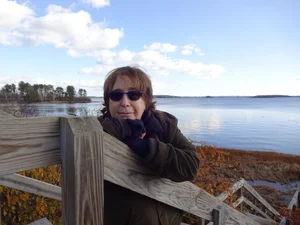
Ashley Kidd, co-founder and conservation program manager of the Sunflower Star Laboratory in California, learned about animal husbandry and scientific diving while working as a biologist in public aquariums. Ashley drew upon her experiences with public aquariums and explored the feasibility of involving them in the research and restoration of the Sunflower Sea Star, a critically endangered marine creature. In 2021, she met Vince Christian, who wanted to start a Sunflower Star Initiative. Within a few months, the Sunflower Star Laboratory was born. It has become a source of hope that sea stars and the kelp forests that depend upon them will once again be a key feature of the nearshore community in the waters off the West Coast.
Sunflower Sea Star Restoration and Kelp Forest Recovery
Ashley talks about how she came to learn about sea stars working at the Aquarium of the Pacific in California. When she discovered they were critically endangered she wondered if public aquariums could be key to restoring the invertebrate populations which are key to the health of the kelp forests. During conversations with other like-minded people on social media she met Vince Christian. Together they founded the Sunflower Star Laboratory in Moss Landing, California. Ashley describes the sunflower sea star and its natural history, their importance in the ecosystem, why they became critically endangered and the work being done to restore them to the wild. Ashley also talks about what people can do to help the sea stars and how to make a difference even if they are not scientists.
-
00:00:02 Pamela Ferris-Olson Today on the Wo(men) Mind the Water Artivist Series podcast on WomenMindTheWater.com, I'm speaking with Ashley Kidd, co-founder and conservation program manager of the Sunflower Star Laboratory in California. Ashley learned about animal husbandry and scientific diving while working as a biologist in public aquariums. She now uses her skills and partnerships forged in aquariums to support research and restoration of the sunflower sea star, a critically endangered marine creature.
00:00:40 Pam Ferris-Olson The Wo(men) Mind the Water Artivist Series podcast on womenmindthewater.com, engages artists in conversation about their work and explores their connection with the oceans. Through their stories, Wo(men) Mind the Water hopes to inspire and encourage action to protect the ocean and her creatures.
00:01:00 Pam Ferris-Olson When Ashley Kidd worked in public aquariums, she learned about animal husbandry, aquaculture, and marine conservation projects. During COVID, Ashley drew upon her experiences with public aquariums and explored the feasibility of involving them in the research and restoration of the Sunflower Sea Star. In 2021, she met Vince Christian, who wanted to start a Sunflower Star Initiative. Within a few months, the Sunflower Star Laboratory was born. The lab, based in Moss Landing, California, is the source of hope that sea stars and kelp forests that depend upon them will once again be a key feature of the nearshore community.
00:01:49 Pam Ferris-Olson Welcome, Ashley. I'm happy that you're here on the Wo(men) Mind the Water Artivist Series podcast. I was near you in Long Beach, California during Christmas, and I had an amazing tour of the Aquarium of the Pacific. One of their conservation projects involved sunflower sea stars. I learned there's a lot of work that goes into raising these creatures. I was excited to learn that the Sunflower Star Laboratory has begun field experiments to see if sunflower stars grown in the lab will survive in the wild.
00:02:26 Pam Ferris-Olson So a little about you. When did you become interested in diving and in conservation of the marine environment?
00:02:33 Ashley Kidd Well, thanks. I'm very happy to be here. And it all began a long time ago when I was certified as a scuba diver in 1998 in Egypt. And I didn't quite understand, I was 12 years old at the time. And I was very excited to be underwater and just in that weightless environment and having that ability to explore as a kid anywhere and everywhere, up, down, all around. But I really didn't put two and two together with being a scuba diver and a scientist until the end of my undergraduate degree.
00:03:16 Pam Ferris-Olson So when did you get interested in sea stars?
00:03:19 Ashley Kidd I came upon sunflower sea stars when they were listed as critically endangered on the IUCN, which is the red list. IUCN stands for the International Union for the Conservation of Nature.
00:03:39 Ashley Kidd And we had sunflower sea stars at the Aquarium of the Pacific. That's where I used to work. So it's great that you have been there. That's those are my old stomping grounds. And it was actually because when I looked, when I was looking up the IUCN Red List listing, they'd mentioned different aquaria that were holding sunflower sea stars and The Aquarium of the Pacific wasn't one of those listed. So I was like: “Oh, what's up with these data sets?” And I just wanted to understand, you know, how data was being compiled to make these assessments.
00:04:19 Ashley Kidd And I used my expertise of just having, being in that field and working with other aquarium specialists, working in aquaculture, working in temperate or cold water, with cold water species to sort of figure out like: Where all these sunflower sea stars are? Where could they be hiding in plain sight in public aquariums? and “Could it be feasible to work with sunflower sea stars in public aquariums to be the basis of a conservation program, whether it was in California or across, you know, its historic range from Mexico to Alaska?”
00:05:08 Pam Ferris-Olson So could you please describe what a sunflower sea star is and why it's proper to call them sea stars and not starfish?
00:05:19 Ashley Kidd Well, really, there's no right or wrong way to call them. Starfish and sea stars are just the common names to describe all the sea stars or the stars that fall under the Class Asteroidea. So from a five-armed starfish, there's thousands of different species. So you can call any star that you see underwater a sea star or a starfish. Some people … don't want people to misinterpret the name starfish as sea stars being a vertebrate because they're invertebrates. They don't have a backbone. But that's a little bit nitpicky, I think.
00:06:02 Ashley Kidd And it doesn't matter whether you call them a sea star or a starfish. If we start from the top down, sunflower sea stars are part of a group of animals called sea stars or starfish. And all these animals share common features. They all start off their life with five arms when they're little newborn settled stars on the sea floor. And they have a water vasculature system, which means they don't have blood. They have basically seawater that courses through their bodies, that helps with digestion, move their tube feet around, move things around their body, and actually inflates them. You know, they actually take in water just to give them that turgor.
00:06:59 Ashley Kidd If you look at a picture of a sunflower sea star, you might say: “Hey Ashley, this sea star doesn't have five arms, it has many arms.” So the cool thing with sunflower sea stars, and there are other species that are multi, more than five arm sea stars, they can just keep adding arms as they grow. Sunflower sea stars have been observed to have up to 24 arms. But even the biggest sea star that I've seen didn't have 24 arms. So it's not like, “Oh, they reach, they grow 24 arms and they're done.
00:07:35 Ashley Kidd Science has not yet explained why sunflower sea stars have varying numbers of arms. There's no like terminal number. So they get the name sunflower because of all those arms. So if you think of the petals of the sunflower, they have multiple arms. They're very fluffy, like the central disc is, looks like all the seeds of a sunflower star. And they are really colorful. I don't think any of them are particularly like a bright yellow, but they're radiantly colored from oranges and blues to purples and reds. And there are yellows and splashes of yellows and they are striped. They have all sorts of very unique colorations.
00:08:23 Pam Ferris-Olson Yeah, what is their importance to the marine community?
00:08:27 Ashley Kidd So their importance in the marine ecosystem is that they are found everywhere and they eat whatever is present. They're not really picky eaters, but in kelp forests where there are sea urchins, and if there are lots of sea urchins, the sunflower sea stars will just eat them up. They have no problem galumphing across the sea floor and mowing down sea urchins.
00:08:58 Ashley Kidd So when we're talking about why sea stars are important in along the coast, again, they live in many different ecosystems or different areas of our nearshore coast. When it comes to kelp forests and helping kelp forests, they have the ability to sort of be that frontline of defense to sort of go clear the area if there were sea stars. Sort of being a security guard moving across these urchin fronts and sort of starting to pick off the urchins that have been starved after they've eaten through a whole kelp forest and the kelp forces haven't come back. So that's one of the big overarching reasons why we're excited to bring or start looking at how bringing sunflower sea stars back may help tip the scales back to a healthy ecosystem by just restoring biodiversity.
00:10:09 Pam Ferris-Olson So why is the sunflower sea star so critically endangered?
00:10:15 Ashley Kidd In 2013, there was a, what we call or have been calling it, a sea star wasting event. Up until recently, we didn't know what could be the source of wasting. And when we say wasting, what people have been describing for years is, just sea stars sunflower sea stars in particular, just dissolving into white patches of goo overnight, like within a day. And it was so shocking because wasting has been observed for hundreds of years in sea stars all around the world, usually with just one species or just one small region. But in 2013, it very rapidly was, it was identified in Washington but very quickly spread down the south, down the south coast, down to Baja, wiping out not just sunflower sea stars, but up to 20 different sea stars were observed with this wasting syndrome. They just turned to goo overnight.
00:11:20 Ashley Kidd So between late 2013 and 2018, it had wiped out five and a half billion sunflower sea stars, which was 95% of the population across its historic range from Baja to Alaska, as well as numerous other species that also showed problems succumbing to this wasting syndrome. And it took researchers over a decade to sort of try to figure out what could be all the different causal factors.
00:12:02 Ashley Kidd So in 2025, we finally got a answer that there is actually a bacteria that can become pathogenic, so it can actually cause disease. And that's called Vibrio pectenicida, or we call it VPEC for short, because it's just easier to say.
00:12:24 Pam Ferris-Olson Let me launch a different kind of question on the positive side. What does it take to raise a sea star to the size that can be returned to the wild, which is what you're doing? And how long does it take to grow the sea stars to that size?
00:12:40 Ashley Kidd Well, the good thing with sunflower sea stars is that they grow really fast. Now, I don't know if you or those listening know how quickly animals grow or don't grow relative to each other but, you know, they start up like tiny little embryos. Under the right conditions they were, you know, 2 1/2 centimeters in six months. Right now at two years of age, we have at our lab, our largest one is 28 or 29 centimeters, so like over a foot and that was at two years. So they're big.
00:13:18 Ashley Kidd They can grow big fast. At 25 centimeters is about the size where they can become reproductively active.
00:13:31 Pam Ferris-Olson Well, I gotta say, if you have people down in Southern California at Scripps all the way up the coast to Friday Harbor and beyond. And you have a sea creature that can grow that quickly and be reproductive quickly. You got all the right elements to bring them back but they still have to deal with this wasting syndrome. So how do you personally cope with the knowledge that these efforts by so many, that are raising and trying to plant the sea stars might not be successful.
00:14:11 Ashley Kidd Oh, I just have reckless optimism. The coolest thing about working in conservation is it is a field that requires the expertise of so many different scientists from developmental larval researchers to disease ecologists to geneticists to field ecologists to cryobiologists and like reproductive experts. And the team that has assembled, that has come together, with sunflower sea stars; with every set of questions that we've put in front of each other and challenged each other to find solutions for, we have been meeting those answers.
So I am very, you know… “Yes, this could be a, there could be a insurmountable wall that we’ll hit at some point.” But what gives me hope is that the action that has been taken, up to this point has been overwhelmingly collaborative. that has led to very speedy results on so many different fields of work. It is just inspiring to be a part of that in a small way.
00:15:54 Pam Ferris-Olson So for those who are listening, who want to do more to assist in the survival of sea stars, how can they help?
00:16:02 Ashley Kidd Oh, everyone can help wherever you are. I mean, what's great, what has been really wonderful to see from, again, we are a community nonprofit. We started because of the community's response to this kelp forest issue and the loss of sunflower sea stars. And the fact that you don't really know what you have till it's gone. And the intricacies of a healthy ecosystem is hard to parse out. Like with, oh, this is the most important animal if we put this one back. That's not how an ecosystem works. It's more nuanced, it's more layered. There's so many different variables. But the fact that through, you know, community, science programs like Reef Check or this is all in California or on the West Coast. Just being out and being vigilant and knowing resources where you can log sightings of sea stars. It's like going to iNaturalist, going out, take a walk on your beach, or on your intertidal rocky reefs. Or if you're a scuba diver and you see something, it's like sounds silly, but if you see something, say something. If something looks out of the ordinary, report it. Go online if you're on Instagram or if you want to check out our website and report a sighting. Or if you go to a place where, you know, you've gone for a long time and you've never seen sea stars, you can also report zeros. Because, you know, just lack of sightings can give us a baseline for if stars do return to that area.
00:17:48 Ashley Kidd But the coolest thing was the Sunflower Star Lab didn't exist. There were no-- Again, there were myself and all the people that formed or co-founded the lab had all individually asked the question, like, “How can I help?” And it just took one person, Vince Christian, to actually say it out loud. Just like when you're in class, it's like, if you're thinking of a question you may as well say it, because like ten other people are probably thinking the same thing. That was sort of how the sunflower star lab began. It just began by saying out loud, saying I want to start a sunflower star restoration program in California. At the time there wasn't any. This was in 2021 just a year after sunflower sea star were listed as critically endangered. And I had just finished, was finishing up, my master's on working with sunflower sea stars and looking at the feasibility of using public aquarium stars to start research into the restoration of this species.
00:18:48 Ashley Kidd And action begets more action. And it was just such an inspiring thing to be a part of, just to be swept up, in truly a community-driven conservation action.
00:19:06 Pam Ferris-Olson Yeah, your passion and your energy are really infectious. So I'm going to say, given the perils that sea stars face in the wild, and your efforts to help them become established, I think that you are well qualified to offer listeners who believe the perils facing the ocean are insurmountable. How can they reframe the issue and work to make a difference?
00:19:32 Ashley Kidd Well, this is taken from Dr. Ayana Elizabeth Johnson, who I take her advice to heart. And it's, you know, in your Venn diagram. You know, what is it that you love doing? What needs to be done? And oh, gosh, I'm going to forget the third part.
But, and like, what skills can you do to lend to it? And if you can put those three things together, you'll find something that you can do. Whether it's well, if you're in finance, and you have no background in biology at all. You can volunteer at nonprofits to help manage finances or project management. Or if you're a woodworker, you know, building systems, or anything, there's always a need. And you can then work vicariously through the science and be a part of it and help. I think the biggest thing is, we don't need to be a scientist to do conservation science. There's so much community involvement as well in collecting data.
00:20:57 Ashley Kidd The work that we've been doing in the last few years, you know, collecting samples and logging sightings. These are so important to building the bigger picture on how these animals will come back. And yeah, don't be afraid.
00:21:23 Pam Ferris-Olson Thank you for joining me on the Wo(men) Mind the Water Artivist Series podcast. I think the work that you are doing is fascinating, and I might even consider it heroic. You helped pioneer a model that offers hope that sea stars and kelp forests may once again thrive off the coast of California. Your efforts are also an example of how people can make a positive difference.
00:21:48 Pam Ferris-Olson I'd like to remind listeners that I've been speaking with Ashley Kidd, co-founder and conservation program manager of the Sunflower Star Laboratory in California. Ashley has been on the forefront of research efforts to restore the Sunflower Sea Star, a marine creature critical to the kelp forest off the coast of California.
00:22:11 Pam Ferris-Olson Ashley Kidd is the latest guest on the Wo(men) Mind the Water Artivist Series podcast. The series can be viewed on womenmindthewater.com and YouTube. An audio-only version of this podcast is available on womenmindthewater.com, on iTunes, and Spotify. Wo(men) Mind the Water is grateful to Jaine Rice for the use of her song, Women of Water. All rights for the Wo(men) Mind the Water name and logo belong to Pam Ferris-Olson. This is Pam Ferris-Olson.